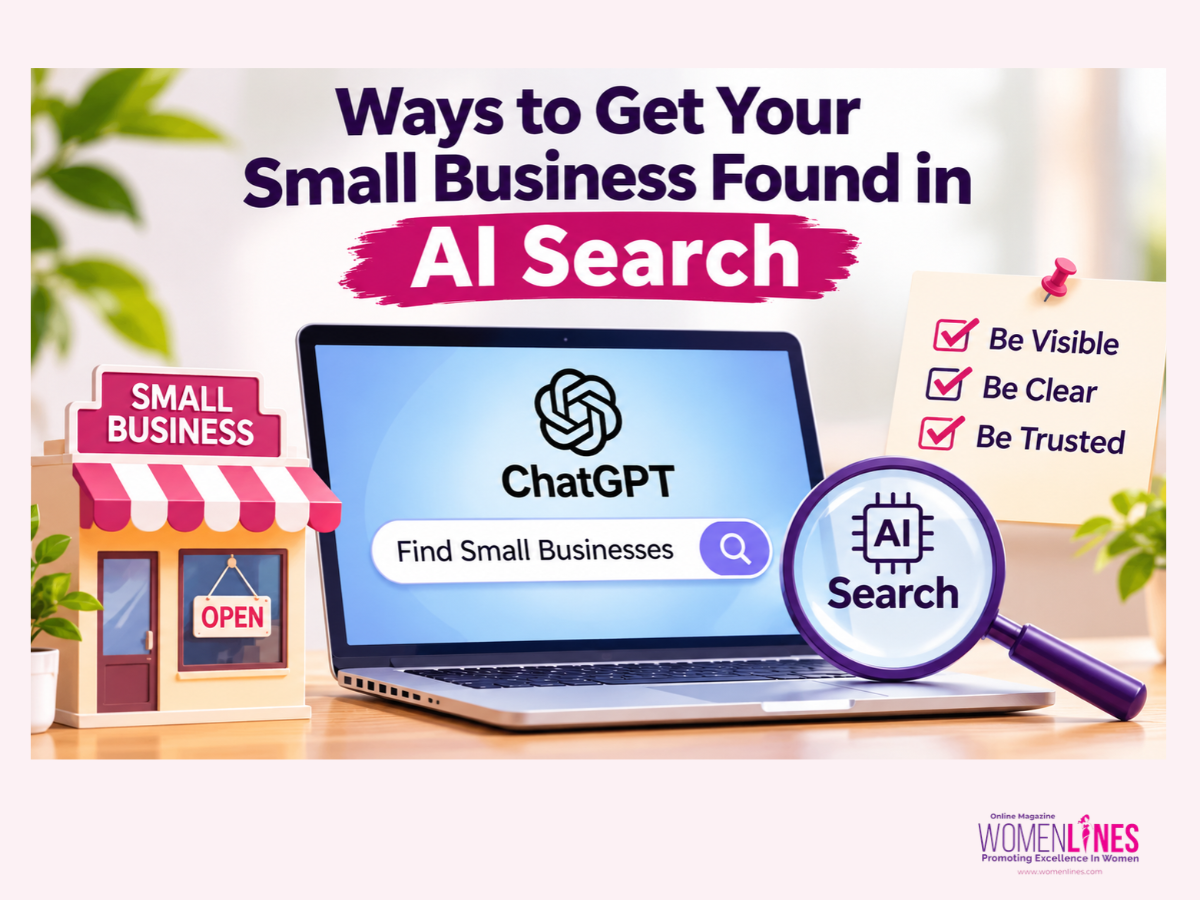
With the rise of AI search, your next customer might not find you through Google. They might simply ask ChatGPT who they should hire. Here are five practical ways to make your small business easier to discover, understand and trust.
Imagine someone opening ChatGPT and asking:
“Can you recommend a reliable marketing consultant for a women-led business?”
Or:
“Which small businesses offer website design and automation services for coaches?”
Would your business appear in that conversation?
For years, small business owners have focused on getting discovered through Google, social media, referrals and paid advertising. But customer discovery is evolving. People are increasingly using AI-powered platforms such as ChatGPT to research services, compare providers, explore options and make purchasing decisions.
This creates a new opportunity for small businesses: AI search visibility.
And no, you don’t need an expensive AI marketing strategy, a technical team or another monthly subscription to start preparing your business.
As someone working at the intersection of marketing, technology and business systems, I’ve noticed that many businesses invest heavily in looking visible on social media but overlook the digital foundations that help search engines and AI platforms understand what they actually do.
The good news? You can start improving those foundations for free.
Here are five practical fixes you can implement today.
1. Make Your Website Clearly Explain What You Do
Your website might look beautiful, but can an AI platform understand your business within a few seconds?
Many small business websites use vague statements such as:
- We help you achieve your dreams.
- Your partner in success.
- Creating experiences that matter.
- Empowering businesses to grow.
These statements might sound appealing, but they don’t explain what you actually sell.
Instead, be specific.
For example, replace:
“We help businesses grow through innovative solutions.”
With:
“We provide website design, email marketing and automation services for coaches, consultants and small businesses looking to generate more qualified leads.”
The second statement communicates three important things:
- What you offer.
- Who you serve.
- What problem you solve.
Your free fix: Review your homepage and service pages. Clearly mention your business category, target audience, services, location (if relevant) and the outcomes customers can expect.
Think about the questions your ideal customers would ask ChatGPT, and make sure your website answers them naturally.
Your website shouldn’t make people guess what you do.
2. Check Whether ChatGPT Can Access Your Website
This is one of the most overlooked technical checks.
Your website may be publicly accessible to people but still have restrictions that prevent certain search crawlers from accessing its content.
OpenAI uses a crawler called OAI-SearchBot to discover websites for ChatGPT’s search features.
If your website blocks this crawler, your pages won’t be included in ChatGPT Search results through its crawling process.
Here’s what you can do:
- Open your website’s robots.txt file by visiting yourwebsite.com/robots.txt.
- Look for rules that restrict OAI-SearchBot.
- If you have access to your website hosting or developer, ask them to ensure OAI-SearchBot is allowed.
- Check whether your hosting provider, CDN or security firewall is blocking its published IP addresses.
You can also ask your developer to review your website’s technical accessibility.
One important distinction: OAI-SearchBot and GPTBot serve different purposes. Allowing OAI-SearchBot for search visibility does not mean you must also allow GPTBot for model training.
You can read OpenAI’s official Overview of OpenAI Crawlers for the technical details.
Your free fix: Ask your website administrator to check your robots.txt settings and crawler access.
Remember, allowing access makes your website eligible to be discovered. It does not guarantee that ChatGPT will recommend your business.
3. Build a Consistent Digital Identity Everywhere
Your business doesn’t exist only on your website.
It also exists on LinkedIn, Instagram, Google Business Profile, industry directories, professional communities and customer review platforms.
Imagine your website describes you as a business coach, LinkedIn says you’re a leadership consultant, and Instagram simply calls you an entrepreneur.
A potential customer might understand the difference, but search and AI systems need to connect these different pieces of information.
Consistency makes that job easier.
Start with these basics:
- Use the same business name across platforms.
- Keep your business description consistent.
- Mention your core services clearly.
- Add your website link to relevant profiles.
- Keep your contact information and business location updated.
- Maintain an active and complete Google Business Profile if you serve customers locally.
Don’t underestimate the importance of third-party mentions either. Genuine customer reviews, interviews, industry features and professional recommendations help establish your business’s presence beyond your own website.
Your free fix: Search your business name online. Review your website, LinkedIn, Google Business Profile and social accounts. Correct outdated information and fill in missing details.
Your digital identity should tell one consistent story.
4. Turn Your Expertise Into Answers People Actually Search For
Here’s where small businesses have a significant opportunity.
People don’t always search using your service name. They search using their problems.
A website designer might receive more relevant discovery opportunities by answering questions such as:
- How much does a small business website cost?
- What should a coach include on a landing page?
- Do I need a website or just a sales funnel?
- How can I automate client onboarding?
Instead of publishing content just to stay active, create genuinely useful resources that answer these questions.
You can start with:
- Five frequently asked questions about your service.
- Three common mistakes your customers make.
- Two practical how-to guides.
- One detailed customer success story.
For example, if you’re a wedding photographer, write an article explaining how far in advance couples should book a photographer, what a wedding photography package includes and how to choose the right photography style.
If you’re a business consultant, explain how to identify operational gaps before hiring more employees.
Make your content specific, useful and based on your actual experience.
If you’re a coach or consultant, you can also explore these 25 lead magnet ideas for coaches to turn your expertise into useful resources for potential customers.
Your free fix: Create one helpful article every month answering a question your ideal customer frequently asks.
Avoid generic AI-generated articles that simply repeat information available everywhere. Your personal insights, experience, examples and expertise are what make your content valuable.
5. Build Trust Through Reviews, Case Studies and Structured Business Information
Being discoverable is one thing. Being trusted is another.
Imagine two businesses offering the same service.
One has a basic website with a list of services.
The other has a website explaining its services, customer testimonials, detailed case studies, founder information, credentials and examples of completed projects.
Which one would you feel more comfortable contacting?
For potential customers, these details provide reasons to trust a business. They also create a stronger body of information about what the business actually does.
Start building that evidence.
Focus on these areas:
- Customer reviews: Encourage genuine customers to share their experiences.
- Case studies: Explain the problem, your approach and the outcome.
- Founder information: Include a real biography, relevant experience and credentials.
- Service details: Clearly describe what customers receive.
- Third-party mentions: Contribute to relevant publications, interviews and professional communities.
- Structured data: Ask your developer or SEO plugin to implement appropriate Organization or LocalBusiness schema where relevant.
Structured data is a way of describing information about your business in a format that search engines can interpret.
You can use free resources such as Google’s Rich Results Test to check eligible structured data.
However, schema is not a shortcut to AI recommendations. Google’s guidance makes clear that there is no special schema requirement for appearing in its AI search features. Accurate, useful content and sound technical SEO remain the priority.
Your free fix: Collect three genuine customer testimonials, publish one detailed case study and review the accuracy of your business information online.
Don’t just tell people that your business is good. Give them evidence that helps them decide.
The Bigger Opportunity: Don’t Just Build a Website. Build a Discoverable Business.
Let’s be realistic.
Making these five changes won’t guarantee that ChatGPT recommends your business tomorrow.
AI recommendations depend on the question being asked, the information available, relevance, source quality and other factors. Different platforms may also produce different results.
But these improvements help establish a stronger digital foundation.
And here’s something I want every small business owner, especially women entrepreneurs building businesses from scratch, to understand:
You don’t need to compete with large companies by spending more money on marketing.
You can start by making your business easier to understand, easier to discover and easier to trust.
Your website should explain what you do.
Your content should demonstrate what you know.
Your online presence should establish who you are.
And your customer experiences should give people a reason to recommend you.
AI is changing how customers discover businesses, but the fundamentals of building trust haven’t changed.
The businesses that make their expertise visible, their information accessible and their value clear will be better positioned for the next era of online discovery.
So, before investing in another marketing campaign, take an hour this week and complete these five free fixes.
Your next customer could be looking for exactly what you offer.
Make sure your digital presence gives them a reason to find you.
About the Author

Krina Shah | Marketing & Business Growth Partner
Website: https://marketing.syndivo.com/
Also read:Practical Ways Women Business Owners Can Use AI to Simplify Everyday Operations
Follow Womenlines on Social Media