For years, when we talked about building brand credibility online, the conversation usually came back to a familiar set of things: build a good website, publish useful content, strengthen your SEO, stay active on social media, collect reviews and earn backlinks.
I still believe all of these matter. But the more I learn about AI discoverability, the more I feel that something deeper is changing underneath them.
We are moving from an internet where people mainly searched for information to one where they can increasingly ask for an answer.
That may sound like a small change in behaviour, but for businesses, I think it is a significant one.
Imagine someone looking for an accountant. A few years ago, they might have searched Google for “small business accountant Singapore”, opened several websites, checked reviews, compared services and eventually made their own shortlist.
Today, that same person can ask an AI assistant:
“Can you suggest a credible accountant in Singapore who works with small businesses?”
Now the technology may help create the shortlist.
That got me thinking about a question I hadn’t really considered before:
When an AI system encounters my name or a business online, what gives it enough confidence to understand who that person or business is — and potentially mention them in an answer?
The more I have been reading and experimenting with this, the more I keep returning to one idea.
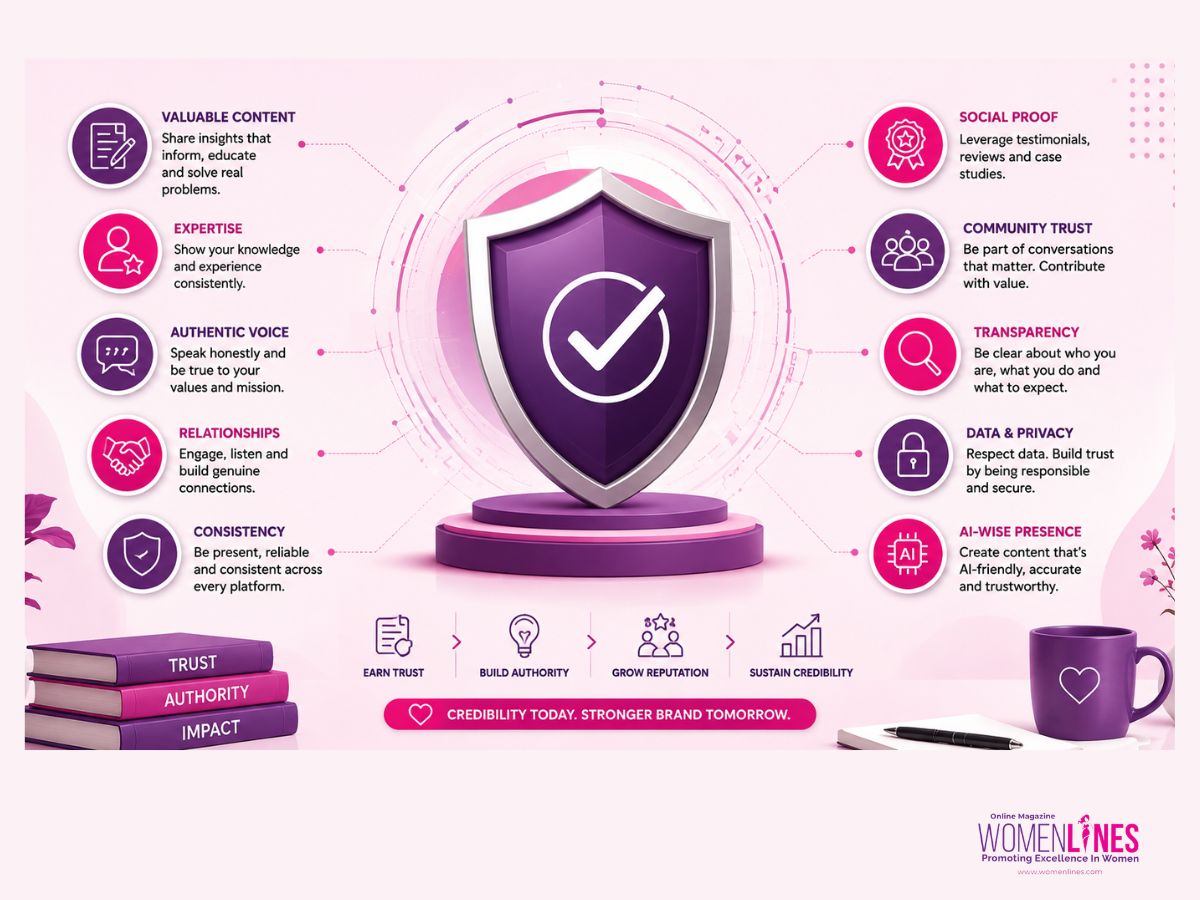
Credibility becomes much stronger when three different voices begin telling a similar story about you.
Your voice.
Other people’s voices.
And now, increasingly, AI’s voice.
I don’t present this as a scientific formula. It is simply the way I have started visualising the new trust equation as I learn more about AI-driven discovery.
The first voice: what we say about ourselves
Every business begins here.
Our website tells people what we do. Our LinkedIn profile explains our experience. Our articles demonstrate what we know. Our videos introduce our personality. Our social media shows what we are working on.
This is our owned narrative, and it is important because if we don’t clearly explain who we are, we cannot expect somebody else — human or machine — to work it out.
But there is an obvious limitation.
We control this layer.
If I write on my own website that I am highly experienced, innovative or trusted, that may be completely true. But a potential customer also knows that I wrote it.
Nobody creates a homepage saying, “We’re fairly average at what we do, but please give us a chance.”
That sounds humorous, but it made me recognise something important:
What we say about ourselves establishes our identity. It doesn’t necessarily establish our credibility.
Credibility becomes more interesting when someone else starts saying it.
The second voice: what the internet says about us
This is where reviews, interviews, independent articles, podcasts, speaking engagements, customer stories, awards, directories and professional collaborations become important.
They are not simply publicity.
They are third-party evidence.
There is a difference between saying:
“I am an expert in this subject.”
and being invited to speak about that subject at an industry event.
There is a difference between saying:
“Customers trust our company.”
and having customers independently describe why they trust it.
There is a difference between saying:
“We produce excellent results.”
and publishing a case study that shows the starting problem, what was done and what actually changed.
In each case, the first is a claim.
The second leaves evidence behind.
And that distinction — between content and evidence — has probably been one of my biggest learnings.
For years, digital marketing has encouraged businesses to produce more. More blogs, more social posts, more videos, more reels.
I’m beginning to wonder whether the next question shouldn’t simply be “How much content are we creating?” but:
“How much credible evidence are we leaving behind?”
Then comes the third voice: what AI understands about us
This is where the subject becomes particularly interesting for me.
AI systems don’t all work in exactly the same way, and I think we should be careful about simplistic claims that there is one formula for “ranking in AI.”
There isn’t.
OpenAI itself states that there is no way to guarantee top placement in ChatGPT Search. It does, however, explain that websites need to allow its search crawler if they want their content to be discoverable for inclusion.
That is an important distinction.
There is no button we can press that says “make AI recommend my business.”
What we can influence is the quality, clarity and availability of the information that exists about us.
And this is where the first two layers start connecting with the third.
An AI system may encounter your own website. But depending on the system and the query, it may also retrieve information from independent articles, reviews, discussions, directories and other sources.
So I have started thinking about AI visibility less as a new marketing trick and more as a digital evidence problem.
If my website says one thing about me, my LinkedIn profile says another, old biographies contain outdated information, and there is very little independent evidence connecting my name to the expertise I claim, I am leaving behind a weak or confusing digital trail.
But if many credible sources consistently connect my name with the same areas of work, there is a much clearer pattern to interpret.
Then I found a statistic that made this feel much less theoretical
While researching this subject, I came across BrightLocal’s 2026 study on AI and local business recommendations.
Nearly half of consumers surveyed had used AI for business recommendations. Among active AI users, 63% said they trusted AI recommendations, and 64% said they trusted tools such as ChatGPT as much as online reviews for local business recommendations.
But another finding interested me even more.
97% of AI users said they sometimes double-check AI recommendations against real reviews.
I think that tells us something important.
AI isn’t necessarily replacing human trust signals.
It may be sitting on top of them.
A person asks AI for a recommendation. AI helps with discovery. The person then checks reviews or other sources before deciding.
That means the old credibility signals haven’t suddenly become irrelevant.
If anything, they may be gaining another audience: machines as well as humans.
Even the SEO industry is changing what it measures
Another moment that made this shift feel very real to me came from Ahrefs.
Most marketers know Ahrefs as an SEO platform associated with keywords, backlinks, traffic and search rankings.
But Ahrefs’ Brand Radar now measures a different set of signals: AI mentions, citations, estimated impressions and AI Share of Voice across AI platforms.
I found this fascinating because measurement tools usually evolve when behaviour starts changing.
For years, one of the most common questions in digital marketing was:
“Where do we rank on Google?”
Now another question is appearing beside it:
“When people ask AI about our category, are we part of the answer?”
There is an important caveat here. These tools cannot see every private AI conversation. Ahrefs itself describes its measurement as a structured, sampling-based approach rather than a record of every AI mention a brand receives.
But the fact that we can now measure AI share of voice at all tells us something about where digital discovery is heading.
AI visibility and AI citation are not the same thing
This was another useful distinction I came across.
A business can be mentioned in an AI response without its website necessarily being cited.
Ahrefs analysed more than 31,000 mentions of its own brand across six AI platforms and found that the AI assistants linked back to Ahrefs only about 28% of the time on average, although the rate varied considerably by platform.
That challenged one of my earlier assumptions.
I had instinctively thought about AI visibility in a way similar to SEO: if a source is important, surely it gets a link.
Not necessarily.
In an AI-first discovery environment, a brand mention itself may have value even when there is no click.
That makes being known for something potentially as important as generating traffic from something.
The research around GEO made me think more carefully too
I have also been reading about Generative Engine Optimization, or GEO.
One of the foundational research papers on GEO reported that certain approaches to presenting information could improve visibility in generative-engine responses by up to 40% in its experimental setting.
That number sounds exciting. But I think the context is just as important as the number.
More recent research reviewing the field cautions that these results do not mean there is a universal technique that will reliably make any website more discoverable across every AI platform. AI retrieval and citation remain variable, and what works can depend heavily on the query, platform and context.
That was a useful reminder for me.
AI discoverability is still evolving. We should learn from the research without turning early findings into marketing guarantees.
This led me to another realisation: consistency isn’t just branding anymore
Suppose your website says you specialise in one area.
Your LinkedIn profile still contains positioning from three years ago.
An old directory lists services you no longer offer.
A guest article gives you an outdated designation.
A podcast describes your company differently again.
A human researching you can probably piece all of that together.
But what happens when an AI system is asked to summarise who you are?
Which version should it trust?
I used to think of consistency mainly as a branding issue — keeping logos, bios and messaging aligned.
Now I’m beginning to see it as something bigger.
Consistency is becoming part of digital reputation management.
The goal isn’t to paste exactly the same biography across fifty websites. In fact, that would feel artificial.
The goal is to make sure the underlying facts are consistent enough that independent sources create a recognisable pattern.
Your digital footprint is becoming your digital reputation
This is perhaps the sentence that best captures what I’ve been learning.
Your digital footprint used to feel like the collection of things you had published online.
Now I increasingly see it as the collection of evidence from which people and machines can form an opinion about you.
Think about what happens when we meet someone in real life.
If they tell us repeatedly how brilliant they are, we remain cautious.
Then someone we trust recommends them.
We become more interested.
Then another person independently says something similar.
We discover they have spoken at a respected event.
We read an intelligent article they wrote.
We find detailed customer feedback.
Eventually, no single piece of information is responsible for our trust.
The pattern is.
That, for me, is the most useful way to understand credibility in an AI-driven world.
Stop making more content. Start creating more evidence.
This is the idea I keep coming back to.
A generic article written because “we need a blog this week” is content.
An article sharing an insight you have developed through years of experience is evidence of your thinking.
“We have happy customers” is content.
Twenty detailed reviews describing specific experiences are evidence.
“We get results” is content.
A case study showing the problem, process and measurable outcome is evidence.
“I understand this industry” is a claim.
Being asked to contribute your perspective to an industry discussion is evidence.
This doesn’t mean every piece of content has to prove something.
It means I am beginning to ask a better question before creating it:
“If somebody finds this six months from now, what will it help them understand or verify about me or my business?”
That question changes the quality of content considerably.
The framework that emerged from my learning: ECHO
After reading and thinking about all of this, I wanted something simple that I could personally remember.
I landed on ECHO.
Not as another marketing formula, and certainly not as a guarantee for appearing in AI results.
For me, it is simply a reminder of four things I want to become more intentional about.
E — Evidence over exposure
Reach matters, but I don’t want reach to be the only measure.
A customer result, an original insight, an independent mention, a useful interview or a strong case study may not always produce the biggest spike in impressions.
But each one strengthens the body of evidence surrounding a person or business.
Exposure tells people you exist. Evidence gives them a reason to believe you.
C — Consistency across credible sources
I want the important facts about my work to remain recognisable wherever someone discovers them.
Not identical sentences.
Not manufactured repetition.
Just consistency around who I am, what I do and what I have actually done.
If humans can understand that pattern easily, there is a better chance machines can interpret it accurately too.
H — Human validation
This may be the part I find most interesting.
The more AI-generated information we encounter, the more valuable genuine human experience may become.
A detailed customer review.
An independent recommendation.
A thoughtful interview.
An invitation to contribute expertise.
A real collaboration.
AI may change how those signals are discovered and summarised, but the underlying trust is still human.
Perhaps one of the best ways to build credibility with machines is still to earn credibility with people first.
O — Optimize for understanding
I originally thought of the O as Optimize for AI Discovery.
But the more I learn, the more I prefer Optimize for Understanding.
That means clear service pages, accurate information, transparent authorship, original expertise, useful answers, sensible structure and content that actually addresses the questions people ask.
OpenAI’s guidance also makes one technical point worth checking: if a business wants its site to be discoverable in ChatGPT Search, it needs to ensure that OAI-SearchBot isn’t being blocked.
But beyond technical accessibility, my bigger learning is this:
Don’t write for an algorithm. Make your expertise difficult to misunderstand.
A simple experiment I now find useful
One practical exercise has helped me look at this differently.
Instead of asking an AI tool:
“What do you know about my company?”
I think it is much more revealing to remove your name completely.
Ask the question your customer would ask.
“Who are credible experts in [your field]?”
“Which companies should I consider for [your service]?”
“What should I look for when choosing a [your category]?”
Then study what comes back.
Which companies or people appear?
Which sources are cited?
What evidence exists around those names?
What have they published?
Where have they been mentioned?
What does the AI appear to associate them with?
One answer isn’t a ranking, and results can change between prompts, platforms and even repeated queries. So I wouldn’t use this exercise to declare that a company is “winning AI.”
I would use it to identify something more useful:
Where are the evidence gaps in my own digital presence?
Maybe I have expertise that I’ve never documented.
Maybe customers appreciate something that isn’t reflected in my reviews.
Maybe I’ve spoken about a subject for years but never published a substantial article about it.
Maybe my biography is inconsistent across the web.
Maybe I am producing plenty of content but very little of it demonstrates first-hand experience.
Those are useful discoveries, regardless of what happens to AI search next.
What I am taking away from this week’s learning
The biggest change in my thinking is that I no longer see AI discoverability as a separate marketing activity.
I see it as the outcome of many things businesses should probably have been doing well anyway: creating genuinely useful information, demonstrating expertise, earning trust, keeping facts accurate, building a credible reputation and making that reputation visible beyond their own channels.
AI simply gives us another reason to take those things seriously.
I’m also becoming more cautious about the rush to find shortcuts.
There will undoubtedly be new techniques, tools and strategies for AI visibility. Some will be valuable. Some will probably disappear as quickly as they arrived.
But reputation has always been harder to manufacture.
And perhaps that’s exactly why it will matter.
Visibility gets you noticed. Credibility gets you chosen.
In the past, we worked hard to become searchable.
Now I think we have another challenge:
Can we become understandable, verifiable — and eventually recommendable?
The answer probably won’t come from publishing another hundred pieces of generic content.
It will come from leaving a stronger trail of evidence.
Our own voice begins the story.
Other people’s voices validate it.
And, increasingly, AI may become another voice that interprets and repeats what it finds.
That is the shift I am trying to understand.
And for now, my biggest learning is this:
Don’t try to tell AI that you are credible. Build a digital reputation strong enough that the evidence can speak for you.
As I explored this subject, I also found myself asking some very practical questions about credibility, SEO and AI discoverability. I’ve gathered the most useful ones below, along with what I’ve understood so far.
1. How can a business build credibility online?
Building credibility online starts with making sure there is clear and trustworthy evidence behind what a business claims. A strong website and useful content matter, but credibility becomes stronger when those claims are supported by genuine customer reviews, case studies, independent media mentions, expert interviews, industry recognition and consistent information across trusted platforms.
One of my biggest learnings has been that online credibility is not built by saying more about yourself; it is built when there is more evidence supporting what you say.
2. How can I make my business more visible on ChatGPT and other AI platforms?
There is no guaranteed way to make ChatGPT, Gemini, Perplexity or another AI platform recommend a particular business. AI systems and their search/retrieval methods also work differently.
What businesses can do is make their expertise easier to discover and understand. That includes publishing clear and useful content, answering specific customer questions, keeping business information accurate, demonstrating first-hand expertise, earning credible third-party mentions and making sure important website content is accessible to relevant search crawlers.
The goal should not simply be to “rank on ChatGPT.” A better goal is to build a digital presence that gives both people and AI systems clear evidence of who you are, what you do and why you are credible.
3. How does AI decide which businesses or brands to recommend?
There isn’t one universal formula that determines which businesses appear in AI-generated recommendations. The answer can vary depending on the AI platform, the user’s question, location, available sources and other contextual factors.
When AI tools use web search or retrieval, they can draw on information from multiple online sources. This is why clear website content, relevant expertise, accurate business information and credible third-party references can all matter.
This is also why I increasingly think about patterns rather than individual rankings. If different credible sources consistently associate a business with a particular area of expertise, the business leaves behind a much clearer digital identity.
4. What is AI discoverability, and why does it matter for businesses?
AI discoverability is the ability of a person, business, product or piece of content to be found, understood, mentioned or cited in AI-generated answers.
It matters because people are increasingly using conversational AI tools to research products, compare services, learn about companies and ask for recommendations.
Traditional search visibility asks:
“Can someone find my website?”
AI discoverability introduces another question:
“Can an AI system understand enough about my business to include it when answering a relevant question?”
For me, that distinction is becoming increasingly important.
5. What is the difference between SEO, AEO and GEO?
SEO (Search Engine Optimization) focuses primarily on improving visibility in traditional search engine results.
AEO (Answer Engine Optimization) focuses on making content easier for search and answer systems to use when providing direct answers to questions.
GEO (Generative Engine Optimization) is an emerging term for improving how content, brands and expertise may be represented or cited within generative AI responses.
There is considerable overlap between all three. Good technical foundations, authoritative content, clear answers, relevant expertise and trustworthy external signals can support more than one type of discovery.
I don’t see GEO as a reason to abandon SEO. I see it as another layer being added to search and digital visibility.
6. Do reviews and media mentions help with AI visibility?
Reviews, independent articles, interviews and other third-party mentions can strengthen the wider digital evidence surrounding a business. They also give potential customers sources beyond the company’s own website when evaluating its credibility.
That doesn’t mean getting one media feature or collecting a certain number of reviews will automatically make an AI platform recommend a business.
Their deeper value is that they create independent validation.
If your website says you are knowledgeable about a subject, that’s your claim. If customers, industry platforms, journalists, podcast hosts or other credible sources independently associate you with that same expertise, the claim begins to become a pattern.
And that pattern is much more powerful than self-promotion alone.
7. Is creating more content enough to improve AI discoverability?
Not necessarily.
This has been one of the most important shifts in my own thinking.
Publishing large amounts of generic content may increase the number of pages on a website, but it doesn’t automatically create authority or credibility.
I would rather ask:
Does this content add new evidence of what I know, what I have done or what customers can trust me for?
Original research, first-hand experience, detailed case studies, expert commentary, useful answers to real customer questions and content containing specific evidence can create a much stronger digital footprint than publishing simply to meet a content calendar.
So my current thinking is:
Don’t measure only how much content you create. Look at how much credible evidence that content leaves behind.
8. How can I check whether my brand is discoverable in AI search?
A simple starting point is to test the kinds of questions your potential customers might naturally ask ChatGPT, Gemini, Perplexity or other AI tools.
Instead of searching directly for your business name, try questions such as:
“Which companies provide [your service]?”
“Who are credible experts in [your field]?”
“What are the best options for [customer problem]?”
Then look beyond whether your name appears. Study which businesses are mentioned, which sources are cited and what evidence seems to support those recommendations.
Results can vary between platforms, prompts and times, so one test should never be treated as a definitive AI ranking.
I find it more useful to treat this as an AI visibility audit: What does the internet currently give AI systems to understand and verify about your business — and what evidence is still missing?
Charu Mehrotra
Founder Womenlines
This article reflects my personal interpretation and simplification of publicly available data from HubSpot’s 2026 State of Marketing Report. I am not affiliated with or endorsed by HubSpot, and Womenlines is not responsible for any decisions made based on this content — please consult the original report for verified, complete data before making business decisions
Also read: Why Some Experts Show Up in AI Answers—and Others Don’t: The New Rules of AI Visibility
Follow Womenlines on Social Media