


It is a pleasure to share about Senior Physiotherapist Shubhangi Gaikwad from the United Arab Emirates as an Influencer for health and fitness at Womenlines panel. A Dedicated PT offering 7 years of acute-chronic care experience; a history of “exemplary” ratings on performance reviews; solid credentials that include, BLS/Dry needling/Manual Therapy certifications /certified FMT and a master’s degree in physical therapy in Neurology. Background includes work with pediatric, adolescent, adult and geriatric patients. This month Shubhangi is sharing tips for how to drive without pain-
In this article, I would like to take the attention of our women followers over the issue which is one of the most advancing factors in relation to pain. Yes, its “Driving”.
Nowadays women are independent and driving most of the time of their own. Many girls who have sales and marketing jobs they spend most of the time behind the wheels. And of course the homemaker, who have responsibilities of the whole house in their shoulder, they keep driving most of the time from picking up and dropping kids, going for shopping, taking a family member to hospital etc, etc, And eventually, we end up in pain in various joints and muscle.
To avoid these, Definitely exercises help us. But another way to avoid these pains is to follow the below preventive steps.
- SINGLE HAND DRIVING: When you drive with one hand there is constant elevation and depression in your shoulder, pulling one side of your paraspinal muscle and constant contraction in your hip muscle. Moreover when you take steep round turns that makes it worse with the extra load on neck and back muscles with constant vigorous firing in buttocks unilaterally. And the arm chilling in window sill getting weaker & weaker day by day. This imbalance between two sides ends up into postural abnormalities.
- Avoid SUPER STRAIGHT SITTING: Constant arching in spine cause fatigue of back muscles. Best way to achieve perfect seating posture is to take your spine into maximum arched position and then release 10% pressure from your back. Use inbuilt lumbar support in your driving seat, inflate it up to the level, so as your hip or waistline does not move forward and you end up in hyperextension of the lower back. If you don’t have inbuilt lumbar support use adjustable cushion available in the market. Also, do not slouch it can give you hunch back.
- WATCH & REMIND YOUR SHOULDER: Hold your wheel in 10-2 o’clock position, maintaining the bend in your elbow. Keep your shoulders relax, unknowingly we shrug our shoulder which makes yours muscle fatigued. So watch out and keep calm around the shoulders.
- SHOES DOES MATTER: Yes! Don’t forget to readjust your seat whenever you are changing your footwear. There will be a definite change in hip and knee angle when you wear thick sole shoes and when you wear flats, which can lead to forwarding rotation in one side of pelvis giving undue pressure in the buttock area and compensatory rotation in spine & shoulder. For ladies who wear a high heel, there are chances of calf muscle strain, shin pain and unwanted knee issues. Try to keep a comfortable pair of shoes for driving.
- HAIR STYLE … Attention girls : I have noticed many girls with big bun and ponytail, keep their neck away from headrest even when they can relax while waiting for signal to open, this leads to stiff neck at the end of the day with neck spasm, and repetitive practise of this leads to straightening of natural cervical curvature and this the beginning of the scary term “Cervical Spondylosis”. So girls be careful, my suggestion is to use a neck pillow, so your neck musculature can take a break, while you shine with your gorgeous look.
Tips for fun driving:
No, don’t exercise while you drive, follow the simple and fun points:
- Use hand brake while in signals. Relax your legs and take off your hand from wheels.
- Check out the cars on your sides, for this, you will move your neck from right to left and repeat, better than grabbing your cellphone and look down to check messages.
- Enjoy music it’s the best stress buster.
- Bhangra groves, yes move your shoulder up &down while enjoying music, see you just worked on your trapezius.
If you have any query regarding any exercises, don’t hesitate to ask in the comment section.
 Shubhangi Gaikwad, Shubhangigaikwad06@gmail.com,
Instagram- sgfitnessguide
Follow Womenlines on Social Media
Womenlines is delighted to share about Anjalika, an IITTI (CANADA) certified professional Image Branding & Lifestyle Consultant, as an Influencer for Image Branding at Womenlines. Yes womenfolk, gear up to learn the tips and tricks to carry yourself with excellence and make excellence your brand. In her sharing for this month, Anjalika is talking about certain etiquettes for Techno-Correspondence-
Brevity
Language
Response time
Reply all
Use BCC feature
A clear, direct subject line
Out of office
Proofread every message
 Zu Anjalika Kamis Gunnulfsen is the Editor (Singapore) for Marketing In Asia and certified Image Branding & Lifestyle Consultant. She was also crowned Mrs Singapore Globe 2017. Born in Singapore and blessed to have lived in a couple of other amazing cities in the world, Anjalika is currently expatriating in Kuala Lumpur. Follow her on LinkedIn, Instagram and blog
LinkedIn –https://www.linkedin.com/in/zuanjalika/
 Womenlines is delighted to welcome Jahnavi Katti, founder of training company ‘Keykonnecct’ and host of youtube show ‘Story2Satori’ as Social Branding and Success Mindset Influencer at Womenlines. Jahnavi is having 20 years of experience in coaching and training and now she wants to share her knowledge across the globe. Every month Jahnavi will be sharing mindset empowering content with Womenlines. Listen to her journey in her own words in the video above-
Jahnavi Katti has two decades of experience and internationally certified expertise as
• Women Entrepreneur Coach – IIM Bangalore
• Social Branding Influencer #Story2Satori for High Powered Women Entrepreneurs
She conducts a series of Master Classes, Webinars Mentoring, Coaching, Skillset & Mindset Training Workshops globally and online. Results Jahnavi’s Clients achieve are:
• Transcend Competition to get Clients
• Develop a Social Branding message
• Convey their message clearly to Clients
• Communicate with Confidence
• Develop Soft Skillsets & Success Mindset
• Manage overwhelm, overcome limiting beliefs and self-doubt
• Live a Lifestyle of Abundance and Joy
• Achieve Success in Business
Jahnavi ‘s Credentials-
• Success Mindset Coach – International Coach Academy Australia
• Mindfulness Coach – Uni.of Massachusetts Boston
• Reiki Master Teacher – Usui Shiki Ryoho
• Lifestyle Consultant Apollo Hospital, Hyderabad
• Training Actor- Kessels & Smit Netherlands
• Award-Winning Script Writer & Short Film Maker- London School of Art & Avid School of Learning, Mumbai
• Silva Method Mind Control Graduate – Laredo, Texas
• Art Of Living – Advance • Landmark Self Expression Coach
• Women Lines & Thrive Global Contributor #Story2Satori BrandShow Host, Upcoming Author, Abundance Mindset Influencer, Lifestyle Entrepreneur, CEO KEYKONNECCT
“I -am inclined towards Holistic Lifestyle and inculcate Silva ie. Subconscious Tapping, Silva Method Mind Control, Reiki, Mindfulness, Coaching and Success Mindset Principles it’s a blend. All this has helped me to deal with life problems and live a purposeful and fulfilling life.”- Jahnavi Katti
Content Sponsor Edumilestones is an India, (Bangalore) based company. It is an India, (Bangalore) based company. They provide a premium career assessment platform and career counseling certification courses named Certified Career Analyst (CCA) and Certified Counselor for International Studies (CCIS) to over 1800+ professionals across 80 locations in India and abroad for over 10 years. They are official members of APCDA and IAAP international organizations. Their team consists of qualified and experienced top experts from psychology, education, design and IT, investing in extensive research and development. This month Ms Zalak Shah a senior psychologist with Edumilestones has shared some great insights on how womenfolk can justify work-life balance in their favour-
Should I quit my job or be a full-time mom? I love my work, I love my family, is there a better way to love both? I have noticed, many of my age women disappearing from the workplace – few after marriage and many after pregnancy.
Though women have been perceived as flexible multi-taskers, society will frown upon them when they work after marriage or pregnancy.
The term ‘work-life balance’ – is it misleading? Does it mean, 100% at work and 100% at home? Crazy! Women are pressured to strike a perfect balance but there is no secret recipe, do you know why? Because balance is a relative term and everyone sees balance differently.
Your work is a part of who you are. It is part of your life and not a separate entity, your family life needs to be in harmony with it. Question is how to integrate different elements of our lives instead of to make them go against each other.
Ways to make personal and work-life co-exist:
1.) Accept it
Life is not a smooth sail for exact balance. The reality is that life ebbs and flows. The ideal balance is a myth, instead, work on what makes you feel balanced or rather what helps you blend it better.
For example: If my son has an important school event, I make sure to arrange my schedule for the day around that, which may mean doing my office work at night while kids are in bed.
2.) Combine work and personal schedules
Putting personal and professional to-do list in one schedule helps you to see the bigger picture and plan accordingly. Be fully present at the choice you made, make sure you are in control of this list. To figure out your priorities ask yourself a few questions:
- What is completely non-negotiable?
- On which tasks will I need perfection
- Which tasks are okay with normal efforts?
- What are the most-important commitments at work and family today?
Figuring answers to these questions will help you prioritize, make adjustments and make you realize what you are not prepared to do.
For example: If I have to drop my daughter to school, but I have a meeting plus need to buy some urgent groceries, I plan my route accordingly or buy groceries from a place near to my meeting spot.
Related Article: Bouncing back after Maternity
3.) Realize your time-wasters
Did you know that distractions at the workplace can cost you more than 2.5 hours a day? If you want to be focused and productive, it’s essential to keep chatty colleagues, social media surfing, and other distractions at bay. Accept that, every choice you make will have its own consequences. Your awareness and acceptance will make it easier for you to decide.
For example: If I plan for one hour to complete a work assignment, I stop at that one hour and don’t spend extra time trying to make it perfect or negotiate with myself. The same applies to clean my house.
Talk about it
Try to be honest and transparent with your seniors and colleagues. Keep them informed, they can help. Let’s say you can’t reach the office on time because you have to take your kid to doctor, they can help you out by keeping your work hours flexible for the day. Do not hesitate to ask for help, remember everyone at work are aiming for the same balance just like you, even your boss.
4.) Divide and Conquer
Decide what you must do yourself and what others can take care of. Seek help from colleagues, spouse, and family members. You and your spouse can divide home tasks in such a way that either of you doesn’t find it overwhelming to do it after a long day at the office. Please note: Your spouse helping you at home, is not a favour. It is their responsibility too.
5.) Make some time for yourself
Making out some time to do things you actually love is the secret to maintain efficiency and productivity. It is okay to think about yourself and pamper yourself. It can be going for movies, watching your favourite series or reading a book, travelling or just doing nothing at all. If you are happy and at peace, then taking care of work and family becomes easier.
Though in this century women are choosing to have everything – a happy family and successful career, still most women feel the pressure to do what is expected of them. This leads them to strive for being super wives, supermoms, and career women.
Instead of thinking of work-life balance – focus on maximizing what you love, both at family and work. It will reduce the burnout rate, make you happier and help you become 60% more efficient and productive at work and home.
-Ms. Zalak Shah is a senior psychologist with Edumilestones. She is the Program Head for Certified Career Analyst course, to enable and empower women with the right attitude, knowledge, and skills to become a successful career counselor.
Womenlines takes pleasure to share about Ms Ketki Vinayachandra as an ‘Influencer of Health’ at Womenlines panel. Ketki is sharing articles and videos related to excellence in health through Naturopathy at Womenlines on first and last Thursdays of every month. The first series ‘Flab to Fab’ is a must watch as Ketki is going to share incredible tips to reduce weight. Ketki is a trained Naturopath and she is quite passionate about creating awareness about Naturopathy across the world. Listen to Ketki in this episode 3 of ‘FLAB TO FAB’-
Calorie input vs output
Its all about the Math!
How do you cut calories
Commit to a healthy body!
 Ms Ketki Vinayachandra, BscM (Hons), ND, AND, Dip Nut, ( Aust), NHAA Member Naturopath, Herbalist, Nutritionist, Iridologist
“As a Naturopathic health practitioner, I strongly believe that we need to invest wisely in our health. The everyday choices we make in terms of our lifestyle and how we treat our body can either create healing or disease. While ageing is inevitable, diseases are not. Talk to me to customize a treatment plan for you today!
Please visit www.askketki.com!
Womenlines is delighted to share about the upcoming Gender Summit on 28-29th August, Level 2, Matrix, Biopolis, Singapore. In the Summit the importance and relevance of gender/diversity dimension for quality and impact of research and innovation will be discussed by 60 international speakers. Singapore Women In Science (SGWIS) are hosting the 2019 Gender Summit. SGWIS is hosting the 16th Gender Summit in Singapore with partnership support from other women in science groups from leading science institutions in Singapore and the Asia-Pacific region. This gender summit will continue the work of previous events to enhance scientific excellence by drawing focus to the presence of gender bias in scientific knowledge-making and to hold space for conversations about advancing gender equality in scientific practises and institutions. The theme for this year’s event is Diversity and Gender in Science: Enhancing the Value of Research and Innovation.
The GS16 is Co-Led by Dr. Vandana Ramachandran (Co-founder SgWIS, Director, Research Affairs & Administration, Singapore Eye Research Institute) and Dr. Lakshmi Ramachandran (Programme Manager, Cancer ImmunoTherapy Imaging, Duke-NUS Medical School). Dr.Lakshmi Ramachandran shares her insights with Womenlines-
1) Unique Opportunity for Singapore
The 16th edition of Gender Summit* is for the first time taking place in Singapore on the 28th and 29th of August at Biopolis. The importance and relevance of gender/diversity dimension for quality and impact of research and innovation will be discussed by 60 international speakers.
The Gender Summit is a global platform for dialogue to help address widespread gaps and biases in science knowledge and innovation, which means that science today has more evidence for men than for women or groups with different ethnicities. The consequence is that quality of research outcomes can be often worse for women, for example, women are 47% more likely to suffer severe injuries from a car crash compared to men because the safety of cars is tested exclusively on data from male crash test dummies. But, there are also missed opportunities to create new markets for science knowledge using basic and translational research, for instance, metabolic profiles of women and men differ in significant ways, which is relevant for developing diagnostic biomarkers for diabetes, and new research has identified sex differences in immune pathways in cancer, which has relevance for developing future immunotherapies. Understanding such fundamental differences and choosing study models that take these into account is important for unbiased research outcomes.
At the GS16, Prof. Sabra L. KLEIN (Johns Hopkins University, the Vaccine Initiative, USA) will present a Keynote Lecture on “Gender perspective on vaccine design and delivery: how understanding basic biology of sex differences can improve public health response to infectious diseases”.
2) Gender dimension in both Science and Society
Good science is needed for a sustainable world. In today’s dynamic and evolving era of digitalization, science and society are interlinked, more than ever. It is important to view society as a whole, where no one is left behind, irrespective of gender, age, status and profession, and everybody can benefit from scientific advances and technological innovations. The Gender Summit examines the socio-cultural differences between men and women in science, and how science can provide more welcoming career paths for women, thereby improving diversity at all professional levels in science.
3) Eminent Keynote Speakers and +60 international speakers
The GS16 Guest of Honour, Ms.CHAN Lai Fung, Chairman Agency for Science Technology and Research (A*STAR), and Permanent Secretary (National Research and Development) will share perspectives from the Asia-Pacific and Singapore.
Prof. Subra Suresh, the president of Nanyang Technological University (NTU) and inaugural Distinguished University Professor (the highest honour given to a faculty member at NTU) will present a Keynote talk on “Digitalisation of societies and economies for a fairer and more sustainable future” at the GS16.
Prof. Curt RICE, who is an American-born Norwegian Linguist and Rector of Oslo Metropolitan University will share a Keynote Lecture on The ‘disruptive’ innovation power of new science institutions: transforming the status quo.
+60 other international speakers from Asia, Europe, North America and Africa will cover major themes on Meeting Societal Challenges, Digitalisation of Society, Disruptive Innovation of Institutions, Implementing Gender Equality, Research Quality and Impact and Women in STEM.
4) Walking the talk- Gender Summit is an inclusive platform
Whether you are a scientist, innovator, gender equality expert, a policymaker, or simply curious to know how diversity and inclusivity of your organization can be improved, the Gender Summit provides ample opportunities for you to learn and grow your network. It is also a truly diverse and global platform involving both men and women at the speaker and attendees level, representing 7000 strong community of experts and practitioners.
5) Be inspired by the Gender Summit 16 story
“Voices can be heard and change can happen when there is conviction and collaboration”. The GS16 is a purely grass-roots level initiative led by the network of Singapore Women in Science, which gathered enough momentum to gain institutional support from various influential science institutes in Singapore and the Asia-Pacific. The GS16 was initiated by Dr. Vandana Ramachandran (Singapore Eye Research Institute SERI; Co-founder SgWIS) and Dr. Lakshmi Ramachandran (Duke-NUS Medical School) with the support from Dr. Elizabeth Pollitzer (below).
* The Gender Summit is a global platform of dialogue created in 2011 in Europe by Dr. Elizabeth Pollitzer, co-founder and Director of Portia, an organization devoted to improving gender equality in STEM and promoting the inclusion of the gender dimension in STEM.
FOR MORE INFORMATION AND REGISTRATION CLICK THE LINKS BELOW:
2) The Gender Summit 16 Programme
3) REGISTRATION (Promocode for 30% corporate group discounts- INDDISC30)
THANKS:
Partners & Generous Sponsors- Agency for Science, Technology and Research (A*STAR), JTC, Elsevier Publishing, The Elsevier Foundation, KPMG Group, Japan Science and Technology Agency (JST), Skin Research Society Singapore, Duke-NUS Medical School, Singapore Eye Research Institute (SERI), Asian Scientist, IDRC/CDRI, CSIRO, ISTeR, ASSAf, GenderInSITE, futurorth, CIHR-IRSC, OSLOMET, Next Einstein Forum
 Dr. Lakshmi Ramachandran, PhD
Talk on the topic ‘Women Empowerment’ by Founder Womenlines Charu Mehrotra at Bringle Academy
Friends, let’s talk about women empowerment!
Believe me, there is something to live by: you’re not alone. Maybe you’re a single mum juggling two jobs, a struggling professional, or a female techie who is competing in a man’s world, self-empowerment can really do wonders in your life!
According to the World Bank:
“Empowerment is the process of increasing the capacity of individuals or groups to make choices and to transform those choices into desired actions and outcome.”
Wikipedia defines Women’s empowerment as the process in which women elaborate and recreates what it is that they can be, do, and accomplish in a circumstance that they previously were denied.
Empowered woman to my understanding is the woman who is very well aware of her capabilities and embraces it fully. To be empowered means to be in control of one’s life and to learn new skills in order to achieve one’s dream.
I strongly believe every woman in this world is blessed with some amazing skills which she can use to create a beautiful life for herself. It is upon her to first get aware about those skills, then work upon those skills by learning and apply her learning practically to create her own space. Though it is not easy and might be challenging also for few but not at all impossible.
Woman empowerment for me is not to get a job from 9 to 5 or only to earn money. It is about how much one has empowered oneself to develop growth mindset or updated oneself with knowledge, related to various topics like health, life skills, entrepreneurship, nutrition etc so she can live a better life. In present time if womenfolk use the power of choice in their favour, they can empower themselves for excellence. It is all about to keep working upon oneself every day and strive to be a better person than before. If womenfolk start getting mindful about how they are spending time, whom they are networking or spending time regularly, are they using the power of choice to read some book instead of gossiping, or maybe using the time to listen to motivational talks to achieve success mindset? Once they start thinking about these topics they will definitely be on the right path of empowerment.
Empowerment also means to help each other. We should also empower ourself to work together. Helen Keller quote-‘Alone we can do so little; together we can do so much.’ is so true. If womenfolk start supporting each other and help each other to grow they can achieve big goals in life. Instead of pulling each other down or getting jealous of each other’s growth one should change mindset to supporting each other. This can be applied in the professional world, entrepreneurial world and also in the community around us. In my previous ventures when I have worked in collaboration with my partners I have achieved big goals which I would have never thought to achieve alone. When I was doing clothing business my fellow partner was skilled with business skills and I was having my marketing and networking skills. The combination was helpful towards setting up of a venture and doing business together and learning and supporting each other in our journey.
Life is beautiful and we all are born to live a beautiful life. I very strongly believe we all are blessed with the right skills and mindset which we have to dig out within ourselves by continuously working upon oneself. Every woman has a right to live an empowered life. An empowered woman can not only create a beautiful life for herself and her family but also contribute to the growth of her nation too. Let’s have a vision of having empowered womenfolk around us who are working together for excellence in life!
Let Excellence be your brand!
Charu Mehrotra
Founder Womenlines Online Magazine
The number of internet users in 2018 was 4.021 billion as per reports and is continuing to grow amazingly. Womenlines innovative digital marketing campaigns can get you digital reach out amazingly!
We all know that Digital Marketing is the must to do marketing for any brand, service, product etc. Womenlines innovative digitalmarketing marketing campaigns can help you to create visibility for your service, product, brand, startup, anything which needs digital reach out.. Womenlines team believes in listening to the client’s story, and as a team come up with an innovative campaign which includes tools like storytelling, latest digital, videos marketing tools, backlinks, hashtags, etc. Share your real story, what value your brand or service brings to people, what exactly your brand is…. email contact@www.womenlines.com to know details!!
Let Excellence be your brand!
Charu Mehrotra
Founder, Womenlines
Womenlines presents ‘Digital Wonders Campaign’ reporting about exclusive brands which can help people to achieve excellence in life.
It is pleasure to share about Yafot Wellness from Singapore which stands out in the field of wellness centres through its holistic offerings based on cutting edge latest technologies along with expert health, nutrition and homoeopathic consultancy to enhance one’s wellness.
Yafot wellness is offering Homeopathic consultancy under Dr Charuta Deshpande, who is having an incredible experience and knowledge, which she wants to use by helping out people suffering from various illnesses especially in a holistic way. Book a free consultation with Dr Charuta Deshpande at Yafot Wellness to have an understanding of how homoeopathic way of treatment can be helpful to you.
This week Dr Charuta is sharing great information regarding how Homeopathy can be helpful in addressing Autism cases in kids. Listen to Dr Charuta and read in her own words how homoeopathy can be used for autism-
*Tell us a bit about your work experience in the area of Autism?
I am Dr Charuta Deshpande, a classical homoeopath specialized in working with special needs. I have been working with Autistic children (3- 17years) for over 6years now, started in Mumbai and then moved to Singapore. Having seen autistic cases from less to most severe, working in multidisciplinary setup, I feel very confident and equipped to continue working in this area. The journey until now has been very humbling and insightful.
*What is unique about Homeopathic approach in cases of Autism?
We treat children with autism, not autism, thus taking an individualized and holistic approach. There is not one autistic child “the same” than another. Our remedy selection is truly based on how your ASD child is different than anyone else. More than the common symptoms of ASD, uncommon and special things about him on mental-emotional-physical spheres are very noteworthy.
The great detail in a case that I look at as a Homeopath, starts right from the Mothers pregnancy or the couples conception history until today looking at the evolution and development of the symptoms of the disease as well understanding the child’s personality at emotional-physical-social levels.
*What changes can be seen with the introduction of Homeopathic remedies?
Improvements are reflected in the area of significant reduction of hyperactivity, behavioural dysfunctions, sensory impairment as well as communication difficulty, the extent of which can differ from case to case. These improvements are translated into better adaptability of the child – emotionally and socially. Also, there is a significant change in the autism rating scores pre and post homoeopathic intervention. Great betterment in the general well being of the child – sleep, mood, physical acute ailments (allergies, gastric upsets) is seen. If you are already on some therapies, you will notice that the child rapidly progresses with the introduction of Homeopathic remedies, continuing the same efforts on the therapy side.
*Is the extent of improvement variable in different cases of Autism?
The degree of improvement also depends whether it is mild, moderate or severe Autism, the age of the child and other factors like the genetic predispositions, co-morbid mental health issues, mother’s pregnancy history – her physical and emotional makeup during pregnancy, current medical treatment history and a few others.
*Can you share one of your clinical experiences with us?
A CASE OF A 4.5YEAR OLD, PARENT’S JOURNEY FROM THE DARK TO VISIBLE HOPEFULNESS
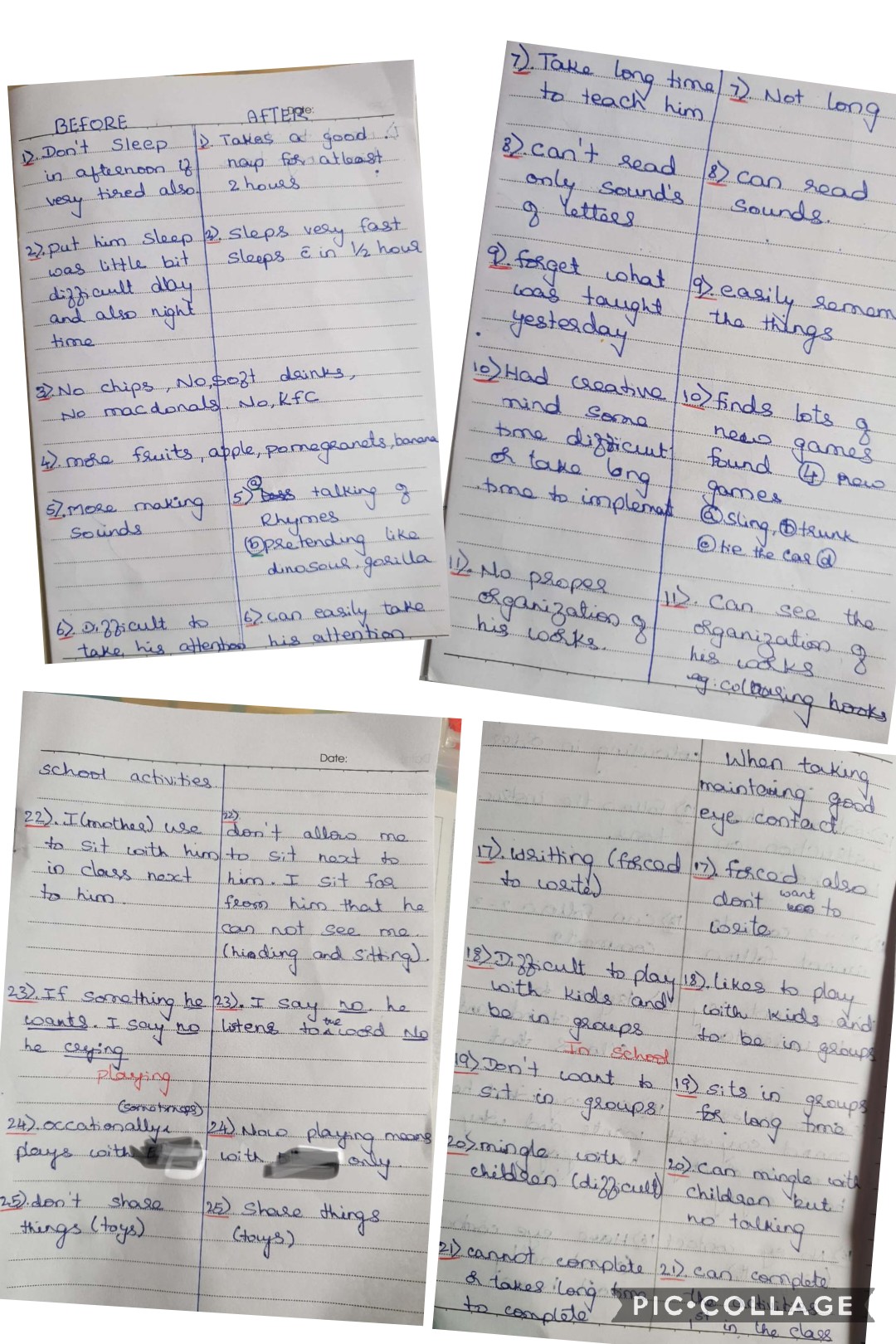
I was called to see this 4.5yr old boy, who was diagnosed to be on the Autism spectrum by one of the reputed hospitals in Singapore. He was referred to me by one of my friends. The parents were initially quite unaware about Homeopathy, left aside its scope in Autism. Just because of a reliable reference from my friend, they decided to give it a try. Some details about the case;
How did everything start: The boy was the elder among the two siblings, who are spaced at a 2year gap. The mother being alone burdened with all the household responsibilities and other commitments could not really focus on the child. Within a year of his birth, she again got pregnant. During all this time, until he was 3yrs, she would just let him watch television so that she can take care of the household and the other baby. Around 3.5years, the parents started realizing that something’s wrong with him being self-centric, no speech and non-interactive. That is when he was diagnosed with being on the spectrum.
Behaviour and Socialisation: At home – Self-focused play, hand flapping when excited or in his own thoughts, hyperactivity if not busy with any activity. Cry often.
At school – He would sit away from the group, cling to a particular toy, no interaction with the kids, poor attention to activities/teachings that don’t interest him.
Speech: Mostly non-verbal, would blabber for need-based communication and make some sounds otherwise
Physical: Recurrent episodes of viral cold and fevers
Not much sensory impairment
2 months after the treatment: Eye contact improved by 70% with others and 90% with the Mother/Father. Hand flapping reduced by 50%. He has started with the monosyllabic conversation. One episode of acute cold/fever, managed with the Homeopathic remedies – settled in 3days. In school, started sitting in the group with his toy on the lap.
4months after the treatment: Eye contact continues to improve further in the time duration. Socialisation markedly improved – he has started playing with his brother, fights with him. Shares his belongings with other kids in school, plays around or sometimes with them in contrast to before where he kept himself fully isolated. The speech further improved, makes need-based communication clearly instead of crying. Clarity with speech better than before.
Parents Take: The parents are more than happy about their decision. They acknowledge the fact that the improvement in the child’s eye contact and hyperactivity is so much, that if a new person sees him for a little while, they won’t even sense that he is Autistic. (Though advised, the child was not any speech therapy, due to some financial constraints)
*A final note that you would like to make?
A multidisciplinary approach is key to improvement in cases of Autism. While the Homeopathic remedies work to enhance the neuropsychological axis, external inputs in the form of training and support are needed to achieve all-round and long-lasting improvement. I promote my clients to regularly visit their developmental paediatricians, psychiatrists, a neurologist at the same time seek support with the required therapies timely.
Disclaimer: The article is written with an objective to share the scope of Homeopathy in autism. It does not intend to promote or demote any other primary or auxiliary treatment modality. It also does not wish to focus on Homeopathy being the sole mode of treatment. Any person willing to go for it can do so based on his personal choice and decision. Individuals consent for treatment, free will to withdraw at any point is what we appreciate.
 Dr Charuta is an M.D in Homoeopathy (Mumbai, India), a certified Counselor (Mumbai), Autism expert and a Speaker. Having 6 years of practice, experience, she specializes in Psychosomatic i.e. stress-related and emotional and psychological disorders.
Address:
360 Orchard Road, #03-16/17, International Building, Singapore 238869
Facebook: https://www.facebook.com/yafotwellness/
Contact no- 6951 1220
E-mail- charutadeshpande@outlook.com
Womenlines is delighted to be a Digital Media Partner for Women’s International Networking (WIN) Conference at Athens. Grab the golden opportunity to nurture the Leader within you at the WIN Conference at Athens from 2-4 (5) October 2019!
The Women’s Initiative and Leadership Organization is based in Lausanne, Switzerland. Women’s International Networking (WIN) founded by Kristin Engvig, is an independent global women’s leadership organization. WIN models develop, empowers and connects leaders in a feminine, authentic and global way. It is the reference for women working internationally and companies active in women’s leadership and diversity & inclusion. It runs the women’s preferred global leadership forum – the WINConference, the WINCorporate Network Group, the WIN Development Fund and the WINCommunity.
A pioneer in the field of professional women’s conferences and leadership journeys on a global scale, WIN has welcomed thousands of leaders and hundreds of companies to live events worldwide
The Global WIN Conference is the most established EuropeanWomen’s forum and leadership development experience has been running since 1998; it has over 20 years of experience in inspiring women worldwide in a feminine, global and authentic way. Giving a framework for change, the WIN Conference has become the reference point for aware women, conscious men, and world-class organisations active in the field of women’s leadership development, talent, diversity and inclusion. Every year more than 800 leaders from across the world join to prepare for the future, to develop possibilities and to realise new opportunities. Participants represent more than 90 nations and demonstrate an ever-increasing level of expertise and influence.
Kristin Engvig, WIN’s visionary founder says:
“I discovered decades ago that bringing together decision-makers from all over the world in one place for a few days where they are united by a common vision is a beautiful and efficient way for all of us to grow, support each other and accelerate the change needed in the world.” We both initiate journeys and nurture those we are on
Why become a part of it?
The environment around us is increasingly complex and fast-changing. As a society, as organizations and as individuals, we are facing many challenges but also many opportunities. It has become vital to stand connected and rooted on the ground as we actively find the new solutions.
WIN prepares you to step up to transform and create thriving organizations and embrace the future emerging.
You will gain the knowledge, awareness, skills and the inspiration needed to propel you and your organization forward.
You will gain hope, inspiration, and vitality.WIN’s Years of experience in feminine leadership assures beauty, abundance, creativity and joy is a part of how each part of this forum is designed, curated and executed. Supported by a clear structure and determination, WIN provides you with a sense of belonging and ease of connecting, making learning and doing business incredibly efficient. Experiencing this integrated way of working will enlighten your life and create ripples to those around you, guaranteed.
WIN participants say they come back with:
- Inspiration, a sense of calm, grace and clarity
- The spark to start new projects and the readiness to take on new roles
- An impactful community of support, meaningful connections and nourishment
- Courage to make bolder decisions
- Confidence to lead more holistically
- Motivation to mentor other colleagues or your teams
- The understanding that ‘I am enough’
- The guts to take authentic action within your company, your community and for yourself
World-class plenaries, skill-building workshops and interactive forums at WIN conference are designed to ignite your curiosity, open your heart to new possibilities, inspire new learning and foster meaningful connections with others. It covers a wide range of topics over 3+ days – there is something for everyone!
WIN is so much more than a conference – it gives you a glimpse into the future and is a total experience that will inspire and energize you.
The conference provides outstanding networking possibilities. Each coffee break, lunch, dinner, and cocktail is created in a way that allows you to connect and engage with someone new.
- 6 Transformative Plenaries – Be inspired by world-class speakers addressing the World, Work and You.
- 42 Growth Workshops – Share, grow and discover interactive and stimulating forum sessions.
- Leading Edge Working Forums– Discuss issues related to media, innovation, technology, women on boards, future of work, women and spirituality, young leader forum, experienced leader forum and the landmark WIN Story forum.
- Innovative D&I Forum– Expert sessions propelling organizations, their talent, and diversity & inclusion programmes to a new level.
- Entrepreneurship Forum– Explorative forum on growing our businesses authentically and organically in a feminine way.
- Coaching Labs– Benefit from professional coaching opportunities and personalized sessions.
- Body-Mind Awakening Session– The perfect way to start the day with 40 minutes of gentle movement and meditation.
- Calm Oasis– Specially designed places to take time out to rest, reflect, refocus and energize.
- Lively Global Village– The marketplace and bookstore.
- Networking Island– Seek advice and share information in the WIN networking area and mentoring corner.
- Conference Rituals – Movement and music to embody and provide a beat for your vision.
- Gala Dinner– Dress up, relax, enjoy and celebrate women around the world.
Why wait? Click REGISTER!