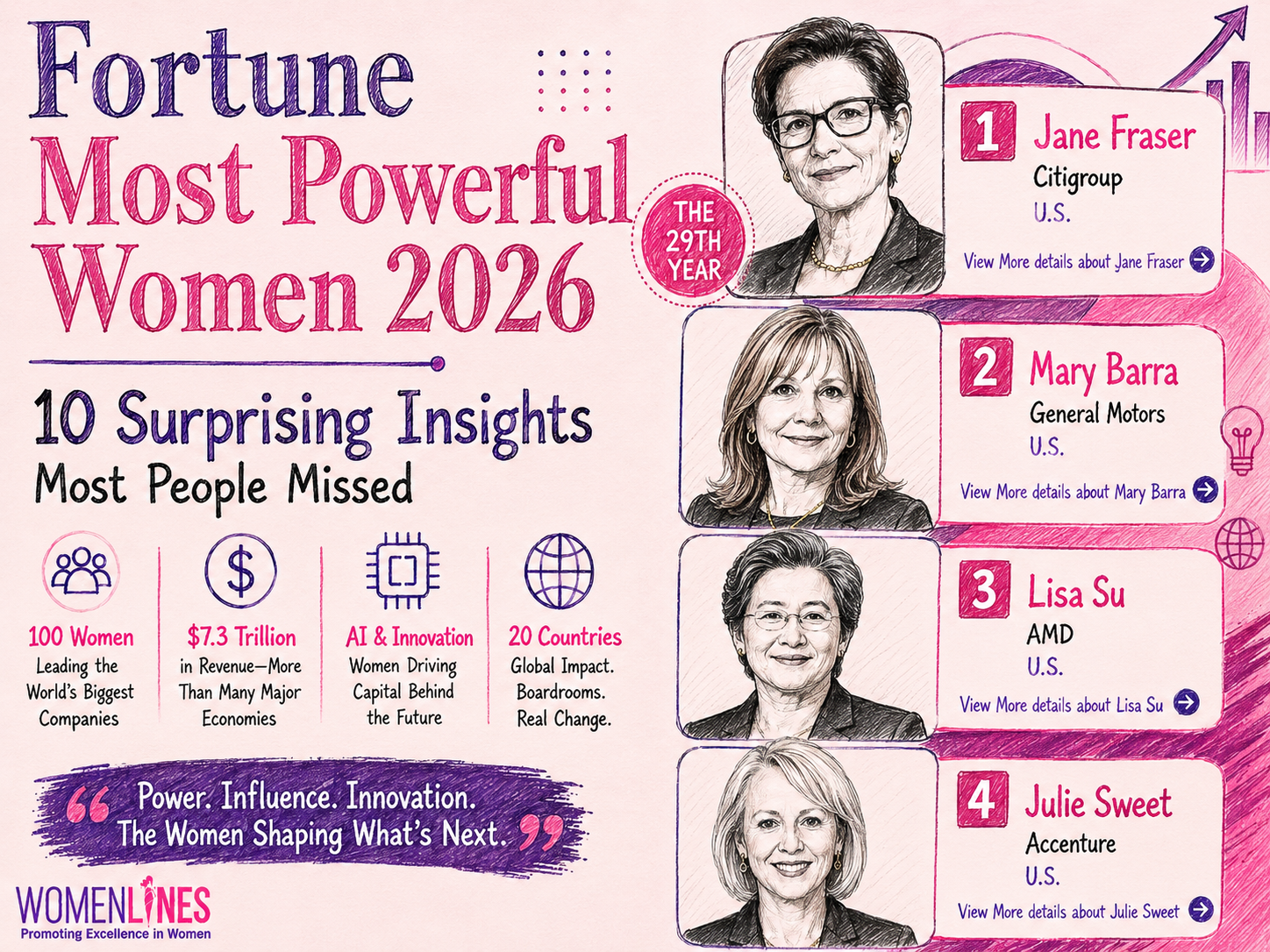
Fortune Most Powerful Women 2026 is out, and once again it offers a fascinating look at the women leading some of the world’s largest companies, industries, and transformations.
I spent time studying the full list, the profiles, the methodology, the newcomer stories, and the data behind each section
Within hours, the internet did what it always does. It shared the headline, named the number one, and moved on.
But if you only read the headline, you missed the actual story.
I went deep into the full list, the profiles, the methodology, the newcomer stories, and the data behind each section. What I found is more fascinating, more surprising, and more relevant to every woman building a career or a business than most of the coverage you have seen.
Here are ten things about the Fortune Most Powerful Women 2026 list that most people who shared it never stopped to read.
1. This Is Not a Forbes List — And the Difference Matters More Than Most People Realise
Let us start with the correction most people do not know they need.
This is Fortune’s list. Not Forbes. They are confused constantly, and the distinction matters.
The Fortune Most Powerful Women in Business list measures power — the real, measurable kind. It scores women on six specific criteria: the size of their business, the health of that business over both a 12-month and a three-year period, their influence beyond their own organisation, innovation, career trajectory, and efforts to make business better in a broader sense. It has been running since 1998.
Forbes publishes a separate, entirely different list: the world’s wealthiest women, ranked by net worth. That is a wealth ranking. Fortune’s is a power ranking. They measure completely different things, and a woman can be on one without appearing on the other — and frequently is.
Understanding which list you are reading changes how you interpret what it means to be on it.
Source: Fortune, About the 2026 Most Powerful Women list https://fortune.com/franchise-list-page/about-the-2026-list-of-the-most-powerful-women-in-business/
2. The Number One Woman Defeated Something Most Senior Leaders Do Not Survive
Jane Fraser, Chair and CEO of Citigroup, took the top spot on the 2026 list — the first time she has ranked number one, five years after becoming the first woman ever to lead a major Wall Street bank in March 2021.
But the story behind that number one is not what most coverage captured.
When Fraser stepped into the Citi CEO role, she walked into a bank with serious problems. Cumbersome IT infrastructure. A complacent management culture. A string of costly mistakes — including an accidental transfer of nearly $900 million to Revlon lenders/creditors. The money went to real creditors but was mistakenly sent in full when only a much smaller interest payment was intended.In her first year, Citi’s stock dropped 15%, lagging the S&P 500’s 10% growth. It was the only major US bank trading below its own book value.
Several analysts pointed to her appointment as a textbook glass cliff moment — the documented phenomenon where women are placed in senior leadership roles specifically at struggling organisations, in conditions that make success nearly impossible.
Fraser did not just survive it. She dismantled it completely.
As of May 2026, Citi’s stock is up about 83% since Fraser took over as CEO. In April 2026, Citi delivered its highest quarterly revenue in a decade. The bank’s return on tangible common equity hit 13.1%, the highest since 2021. The Fortune press release uses a slightly higher “more than 90%” figure which includes total shareholder return including dividends — both figures come directly from Fortune’s own reporting.
She moved from number three on the 2025 list to number one in 2026. That is not a small jump. That is what five years of executing a turnaround under the full scrutiny of global finance looks like when it works.
Sources:
- Fortune: Jane Fraser individual profile, 2026 MPW list https://fortune.com/ranking/most-powerful-women/2026/jane-fraser/
- Fortune: Jane Fraser defied the glass cliff to engineer Citi’s turnaround https://fortune.com/2026/05/28/jane-fraser-defied-glass-cliff-citi-turnaround-mpw/
- Fortune: Citi’s 5-year comeback https://fortune.com/2026/05/27/most-powerful-women-citigroup-ceo-jane-fraser-turnaround-big-banks-wall-street/
3. The Companies Led by These Women Generate More Revenue Than Many Major Economies
The 100 women on this year’s Fortune Most Powerful Women list lead companies with a combined 11.8 million employees and $7.3 trillion in annual revenue…
To put that into perspective, the companies led by these women generate a combined $7.3 trillion in annual revenue—larger than the GDP of many major economies, including Japan, Germany, and the United Kingdom.
Sources:
- Fortune, About the 2026 Most Powerful Women list https://fortune.com/franchise-list-page/about-the-2026-list-of-the-most-powerful-women-in-business/
- Statista: GDP of G7 countries 2025 (Japan $4.28T, Germany $5.01T, UK $3.96T) https://www.statista.com/statistics/1370584/g7-country-gdp-levels
4. Women Are Playing a Critical Role in Funding the Future of AI
Several of the world’s most influential AI companies now have female CFOs overseeing capital allocation and financial strategy.
But the real insight is hidden inside that fact. The 11 finance chiefs on the 2026 list include Amy Hood, EVP and CFO of Microsoft (No. 38); Anat Ashkenazi, SVP and CFO of Alphabet and Google (No. 48); Colette Kress, EVP and CFO of Nvidia (No. 49); and Sarah Friar, CFO of OpenAI (No. 90). Nearly every major player shaping the future of AI has a female CFO controlling its financial decisions.
These women are not supporting the AI industry. They are deciding how hundreds of billions of dollars in AI investment get allocated — which research gets funded, which products get built, which companies survive the race, and which ones do not.
As Fortune’s Most Powerful Women editor Emma Hinchliffe observed directly: “Nearly every major player in AI has a female CFO leading its finance operation. These women are making spending decisions that will determine the future of their companies, this technology, and even the global economy.”
The public conversation about women and AI focuses almost entirely on representation gaps — how few women are building or leading AI companies. That conversation is important. But it is missing something that is already true: women are already making the most consequential financial decisions in the AI industry, right now.
Source:
- Fortune: The 2026 Fortune Most Powerful Women list — and 11 CFOs made the cut https://fortune.com/2026/05/27/fortune-most-powerful-women-list-2026-cfo/ https://finance.yahoo.com/markets/stocks/articles/2026-fortune-most-powerful-women-121113805.html
5. More Than 30 Fortune 500 Female CEOs Did Not Make This List — and That Is the Point
This surprises almost everyone who hears it.
There are more than 50 female Fortune 500 CEOs in the United States right now. Only 20 of them made the 2026 Fortune Most Powerful Women list. More than 30 Fortune 500 CEOs did not make the cut.
You can run one of America’s 500 most powerful companies and still not be considered one of the 100 most powerful women in business globally.
That is because Fortune is not rewarding titles. It is rewarding what women are actually doing with their roles — the health of the business they lead, the influence they are building beyond their organisation, the innovation they are driving, and the broader impact they are having on business as a whole.
A large title sitting on a stagnant business scores lower than a smaller role with demonstrable impact and strong upward momentum. That is a far more honest and demanding standard than most rankings use — and it is what makes this list genuinely meaningful to appear on.
Source:
- Fortune 2025 Most Powerful Women methodology (consistent with 2026) https://fortune.com/2025/05/20/fortunes-2025-most-powerful-women-list-is-here
- CNBC Changemakers 2026: Women still comprise just 11% of Fortune 500 CEOs https://www.cnbc.com/2026/02/25/changemakers-women-ceos-founders-success-leadership.html
6. Nearly Half This List Comes From Outside the United States
Almost half of the 100 women on the 2026 Fortune Most Powerful Women list are based outside the United States. Behind the US, mainland China has the highest number of honourees at nine, followed by France and the UK with six each. Brazil, Germany, and the UAE each have three. Australia, Hong Kong, Singapore, South Africa, South Korea, and Spain each have two.
The United Arab Emirates — three women on the world’s most rigorous ranking of female business power. This is a country that Western gender equality conversations frequently overlook when discussing where women’s leadership is emerging globally. And yet three of its businesswomen sit on this list.
As Fortune Editor in Chief Alyson Shontell put it: “In its 29th year, this iconic list of powerful women includes almost half from outside of the US, reminding us that the impact of women’s leadership is being seen globally.”
Women’s business leadership is not a Western story. It never was. The 2026 list makes that undeniable.
Source:
- Fortune, 2026 Most Powerful Women in Business — full announcement https://www.prnewswire.com/news-releases/fortune-reveals-the-100-most-powerful-women-in-business-2026-list-302782265.html
7. A Significant Milestone for Female Leadership in Global Energy
Meg O’Neill’s appearance highlights a significant milestone for female leadership in the global energy sector.
She is the first female CEO of a major oil company to appear on the Fortune Most Powerful Women list in its 29-year history. The global energy sector has been one of the last major industries where women were almost entirely absent from the very top of the leadership structure. O’Neill’s debut at number 16 — ranked higher in her first year than many long-established names — signals a genuine structural shift in one of the world’s most traditionally male-dominated industries.
Source:
- Fortune, 2026 Most Powerful Women list — full announcement https://www.morningstar.com/news/pr-newswire/20260527ny68091/fortune-reveals-the-100-most-powerful-women-in-business-2026-list
8. The Growing Influence of Digital Assets in Global Business
Yi He’s inclusion reflects the growing influence of digital assets and crypto businesses in the global economy.
For 28 years, this list was populated almost entirely by leaders of traditional, regulated, publicly listed institutions — banks, healthcare companies, technology giants, retailers, and energy companies. Yi He’s appearance is the first of its kind on this ranking. It signals clearly that for purposes of measuring where business power actually sits in 2026, the line between traditional finance and digital assets has not just blurred — it has dissolved.
A female co-founder of the world’s largest cryptocurrency exchange sitting alongside the CFO of Microsoft and the CEO of Citigroup on the same power ranking is not a novelty. It is the list catching up with where capital and influence actually moved.
Source:
- Fortune, 2026 Most Powerful Women list — full announcement via Morningstar https://www.morningstar.com/news/pr-newswire/20260527ny68091/fortune-reveals-the-100-most-powerful-women-in-business-2026-list
9. None of Them Started at the Top — and Fortune Documented It
This is the insight that landed hardest when I read the companion piece Fortune published two days after the main list.
Before boardrooms and billion-dollar decisions, the 100 leaders on this year’s list were somewhere very different. Some stood on factory floors. Some stocked shelves at Target. Some worked as cabin crew on commercial flights. Some began in entry-level Wall Street cubicles and worked their way forward one desk at a time.
Almost none of them had a clear map to where they ended up.
What united them, Fortune observed, was not a prestigious starting point or a perfect plan. It was a willingness to adapt, to outwork expectations, and to take opportunities when they appeared — even when those opportunities looked nothing like what they had imagined for themselves.
The most powerful women in global business in 2026 started exactly where most people start. The distance between their beginnings and where they now sit was not talent alone. It was sustained, unglamorous, consistent forward motion — taken one decision at a time, often without certainty about where it would lead.
Source:
- Fortune: From Target stockrooms to factory floors — the first jobs that shaped Fortune’s Most Powerful Women 2026 https://fortune.com/2026/05/29/fortune-most-powerful-women-2026-first-jobs-from-target-stockrooms-to-factory-floors-early-career-foundations/
10. The List Has Been Running 29 Years — and It Tracks Something More Important Than Names
The Fortune Most Powerful Women list started in 1998. That was the year Google was founded. It was four years before LinkedIn existed. It was a world in which the idea of a woman leading a major Wall Street bank was not just uncommon — it was functionally unimaginable in the culture of global finance.
In 29 years, this list has tracked women moving from the margins of corporate power to its centre. From HR and communications roles — the directions women were historically steered toward — into technology, finance, energy, artificial intelligence, and cryptocurrency. From being absent on lists like this to collectively leading companies that generate trillions of dollars in annual revenue.
And critically: the list breathes. It is not a fixed hall of fame. Women enter and exit each year based on what they are actually doing. The criteria do not reward someone for occupying a seat. They reward someone for using it.
In 2026, the answer to what counts as power in business is clear. It belongs to women who are building, turning around, funding, and shaping the future — regardless of their industry, their geography, or the conventional prestige of their sector.
The only thing this list has never rewarded, across 29 years, is standing still.
Source:
- Fortune, 100 Most Powerful Women in Business 2026 — full list https://fortune.com/ranking/most-powerful-women/2026/
All Sources Referenced in This Article
- Fortune: 2026 Most Powerful Women in Business — full list https://fortune.com/ranking/most-powerful-women/2026/
- Fortune: About the 2026 Most Powerful Women list (methodology and data) https://fortune.com/franchise-list-page/about-the-2026-list-of-the-most-powerful-women-in-business/
- Fortune: 2026 Most Powerful Women list — new No. 1 Jane Fraser https://fortune.com/2026/05/27/most-powerful-women-list-2026-jane-fraser-citi/
- Fortune: Jane Fraser individual profile, 2026 MPW list (83% stock figure) https://fortune.com/ranking/most-powerful-women/2026/jane-fraser/
- Fortune: Jane Fraser defied the glass cliff — Citi turnaround story https://fortune.com/2026/05/28/jane-fraser-defied-glass-cliff-citi-turnaround-mpw/
- Fortune: Citi’s 5-year comeback under Jane Fraser https://fortune.com/2026/05/27/most-powerful-women-citigroup-ceo-jane-fraser-turnaround-big-banks-wall-street/
- Fortune: The 2026 Fortune Most Powerful Women list — 11 CFOs (with full CFO list) https://fortune.com/2026/05/27/fortune-most-powerful-women-list-2026-cfo/ https://finance.yahoo.com/markets/stocks/articles/2026-fortune-most-powerful-women-121113805.html
- Fortune: 2026 Most Powerful Women — full press release https://www.prnewswire.com/news-releases/fortune-reveals-the-100-most-powerful-women-in-business-2026-list-302782265.html https://www.morningstar.com/news/pr-newswire/20260527ny68091/fortune-reveals-the-100-most-powerful-women-in-business-2026-list
- Fortune: From Target stockrooms to factory floors — first jobs of MPW 2026 https://fortune.com/2026/05/29/fortune-most-powerful-women-2026-first-jobs-from-target-stockrooms-to-factory-floors-early-career-foundations/
- Fortune: 2025 Most Powerful Women — methodology reference https://fortune.com/2025/05/20/fortunes-2025-most-powerful-women-list-is-here
- CNBC Changemakers 2026: Women still just 11% of Fortune 500 CEOs https://www.cnbc.com/2026/02/25/changemakers-women-ceos-founders-success-leadership.html
- Statista: GDP of G7 countries 2025 (Japan $4.28T, Germany $5.01T, UK $3.96T) https://www.statista.com/statistics/1370584/g7-country-gdp-levels
Disclaimer: All statistics, rankings, company performance data, and leadership information referenced in this article are derived from publicly available reports and original sources cited within the article.While every effort has been made to ensure accuracy, Womenlines and the author assume no liability for errors, omissions, or subsequent changes in information. Trademarks, company names, and brand references remain the property of their respective owners.
Author
Charu Mehrotra
Founder Womenlines
Also read: Women in AI: The Future of Female Leadership in Technology
Follow Womenlines on Social Media