
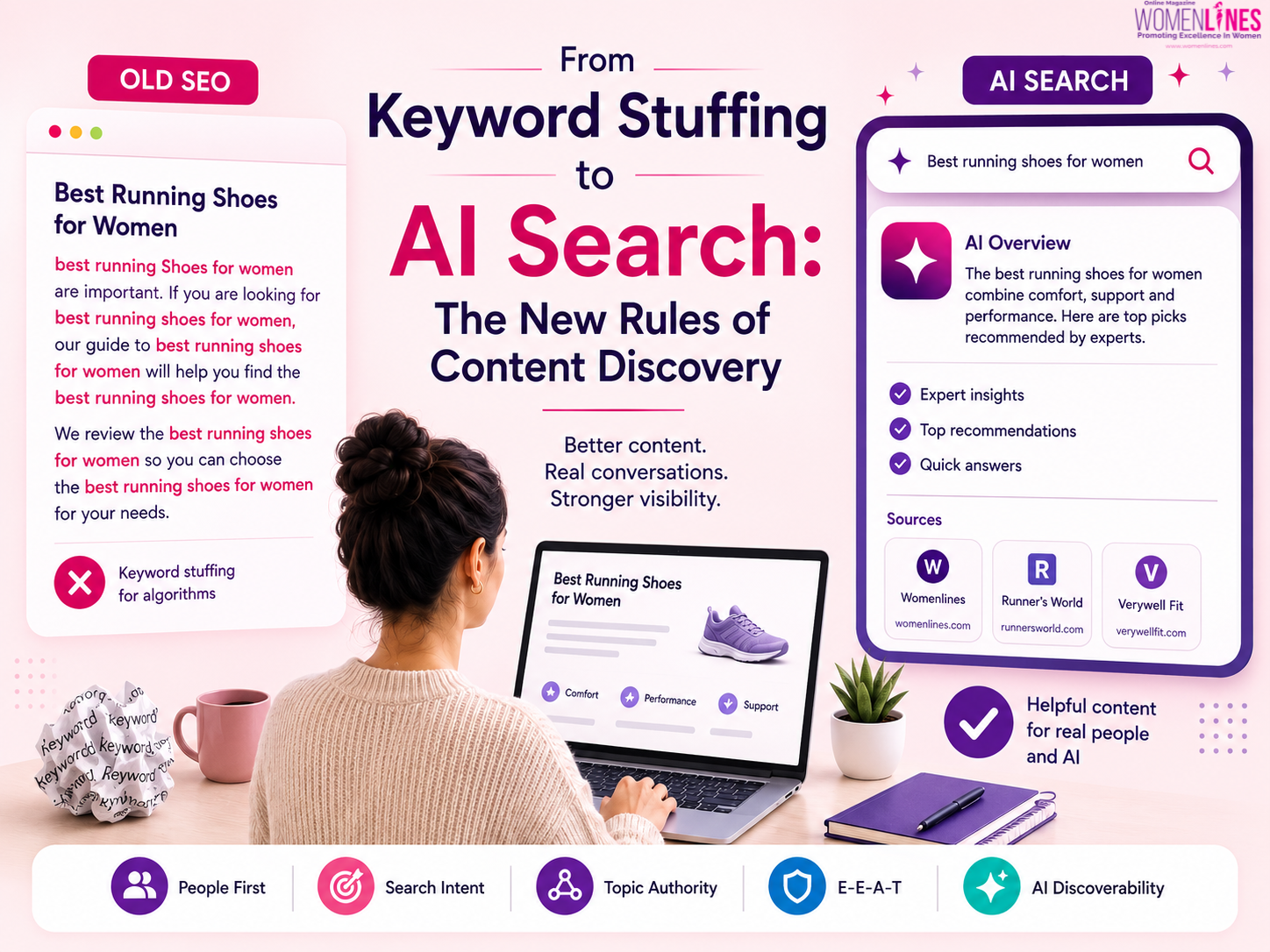
When I started Womenlines, the rules of digital content felt almost mechanical. You picked a keyword, and you repeated it — in your title, your first paragraph, your image alt text, your headings — as many times as you could get away with, because that’s what got you seen. Content wasn’t written for people first. It was written for a crawler.
Looking at where things stand now, it’s a genuinely different world.
The end of the keyword-stuffing era
Search engines didn’t wake up one day and decide keyword stuffing was bad — it was a slow correction, update by update. Google’s Penguin update in 2012 cracked down on manipulative SEO tactics, particularly unnatural link schemes and other forms of webspam, while Google continued improving its ability to detect keyword-stuffed content. The following year, Hummingbird introduced semantic search, teaching Google to focus on the meaning behind a query rather than matching exact words. RankBrain (2015) added machine learning so the engine could interpret intent even for queries it had never seen before. BERT (2019) took that further, giving Google a much deeper grasp of context and nuance in long or conversational searches. And the Helpful Content Update in 2022 made it explicit: content should be written for people, not for search engines.
The upshot for anyone writing today: chasing a keyword-density percentage is no longer a meaningful strategy. In fact, forcing a phrase into a page again and again can now read as spam — the very thing search engines are increasingly able to recognise and devalue.
What replaced it
None of this means keywords disappeared. They still help search engines understand the primary topic of a page. The difference is that keywords now provide context rather than acting as a ranking shortcut.
Semantic SEO and topic clusters. Rather than repeating one phrase, the modern approach is to build a network of content around a topic — a strong pillar page on the broad subject, supported by articles that answer the specific questions people actually have, all linked together. It signals depth of understanding rather than repetition.
E-E-A-T — Experience, Expertise, Authority, Trust. Google’s quality systems increasingly favour content that demonstrates genuine experience, expertise, authority and trustworthiness. Bylines, credentials and genuine first-hand experience all help establish credibility for readers and search engines alike.
GEO — Generative Engine Optimization. This is the newest and arguably biggest shift. What many marketers now call Generative Engine Optimization (GEO) focuses on making content easy for AI-powered search experiences to understand and reference. With AI Overviews now answering many queries directly at the top of the search page, a new goal has emerged: getting your content cited inside the AI-generated answer, not just ranked below it.
The number that tells the whole story
If there’s one statistic to hold onto, it’s this: the “zero-click” search rate — searches where the user gets their answer without visiting any website — has climbed from around 50% in 2019 to nearly 68% today. When an AI Overview appears on a search, that number can jump to over 80%. One large SparkToro study found AI Overviews now show up on more than one in five Google searches, and when they do, click-through to actual websites drops by nearly 60%.
It’s not uniform, though. Some studies suggest branded searches may see higher click-through rates when AI Overviews appear because users are already looking for a specific company or website. And e-commerce searches trigger AI Overviews far less often, so shopping-related content is relatively insulated for now.
What keyword stuffing actually looked like (and why it stopped working)
It’s worth remembering what the old approach really looked like on the page, because the contrast is what makes the shift click for readers.
Say you ran a bakery blog and your keyword was “best chocolate cake recipe.” The old-school version might read like this:
“Looking for the best chocolate cake recipe? This best chocolate cake recipe uses simple ingredients. Our best chocolate cake recipe is easy to follow and gives you the best chocolate cake recipe results every time.”
Four repetitions in three sentences, and the reader learns almost nothing. That kind of writing used to genuinely move a page up the rankings. Today it does the opposite — search engines increasingly recognise it as an attempt to manipulate rankings rather than help a person, and it can hurt visibility.
Here’s the same intent, written the way it would be approached now:
“This chocolate cake comes together with pantry staples — cocoa powder, buttermilk, and a splash of coffee to deepen the flavour. It’s the recipe I go back to for birthdays because it stays moist for days and doesn’t need frosting to taste rich.”
Notice the topic — chocolate cake — is still completely clear from context. But instead of repeating the exact phrase, the writing naturally pulls in related terms that search engines and language models associate with the same topic: cocoa powder, buttermilk, moist, frosting, birthdays. That’s semantic writing. The “keyword” isn’t gone; it’s simply no longer treated as a phrase to repeat, but as the starting point for covering a topic naturally and comprehensively.
How to actually place words in present-day writing
A few concrete habits that replace the old stuff-it-everywhere approach:
1. Say it once, clearly, near the top — then let it breathe.
Your main topic should appear naturally in your title, your opening paragraph and maybe one subheading. After that, stop counting repetitions and start answering the reader’s actual question.
Old habit: Repeat “work from home jobs for women” eight times across 600 words.
Now: Mention it once in the title and introduction — “Work-from-home jobs for women have grown well beyond data entry and virtual assistance” — then spend the rest of the piece naming actual roles, skills needed and platforms, letting related phrases (remote work, flexible hours, freelance income, side hustle) appear wherever they’d naturally occur in a real conversation.
2. Write in the same words your reader would type or say out loud.
People now search — and increasingly ask AI tools — in full sentences: “What’s a good side hustle for a working mum with two kids?” rather than “side hustle mum.” Structure at least one section of your article as a direct answer to a question phrased conversationally, ideally as a subheading. It reads naturally to a human and also aligns with how AI systems identify and reuse helpful content.
3. Cover the neighbourhood of the topic, not just the topic.
If your subject is “financial independence for women,” the surrounding vocabulary — emergency funds, retirement accounts, salary negotiation, budgeting apps, financial literacy — should appear because you’re genuinely covering the ground, not because you inserted them for SEO. A reader (and a search engine) can tell the difference between a term that’s discussed and one that’s simply dropped in.
4. Use descriptive links and alt text instead of exact-match phrases.
Old habit: Linking the exact phrase “best budgeting apps for women” every single time you link to that article.
Now: Vary it — “the budgeting app comparison I put together,” “this piece on tracking spending,” “our budgeting roundup” — the same way you’d naturally refer back to something in conversation.
5. Let your own voice and experience carry the piece.
Instead of writing generically towards a keyword, write from something you actually know. A line like “When I first started freelancing, I underpriced myself for almost a year before I understood how to negotiate” does more for both readers and visibility than any repeated phrase — it’s the kind of first-person specificity that Google’s quality systems increasingly reward.
The common thread across all five: the keyword becomes a topic you’re demonstrably knowledgeable about, rather than a phrase you’re repeating. Say it plainly once, then talk about it the way you would to a friend who asked you a real question.
What it means for writers like us
- Write to be the source an AI would quote. Clear, specific, well-structured answers to real questions beat repetition every time.
- Go deep, not wide. Covering a topic thoroughly — the related subtopics, the nuances and the follow-up questions — matters more than optimising one phrase.
- Let your experience show. Bylines, real stories and visible expertise help build trust with both readers and search systems.
- Keywords still matter, just differently. Your core topic should still be clear and your important terms should appear naturally — they’ve simply stopped being a quota to hit.
The keyword-stuffing years taught us to write for machines. What’s changed is that the machines have become much better at recognising when we’re genuinely writing for people — and rewarding content that is useful, trustworthy and worth referencing.
Sources and further reading
- Google Search Central – Helpful Content & Search Essentials
- Google Search Quality Evaluator Guidelines (E-E-A-T)
- Search Engine Land – Zero-Click Search Studies
- SparkToro – Zero-Click Search Research (2026)
- Keywords Everywhere – Do Keywords Still Matter for SEO in 2026?
- Digital Applied – Zero-Click Search Statistics 2026
Author –
Charu Mehrotra
Founder Womenlines
Editorial Note: Article is designed to help entrepreneurs and business leaders make sense of the rapidly evolving world of AI, digital marketing, branding, and online visibility. Every edition is carefully curated from credible industry research, trusted publications, and practical insights, then simplified into actionable takeaways. While every effort is made to ensure accuracy, AI technologies and digital platforms evolve continuously. The views expressed are intended to educate and inform rather than guarantee specific business outcomes.
Frequently Asked Questions
1. Does keyword stuffing still work in SEO?
No. Keyword stuffing is considered a spammy SEO practice and can reduce content quality. Modern search engines reward content that answers user questions naturally instead of repeating the same keyword excessively.
2. What is semantic SEO?
Semantic SEO is the practice of creating content around a complete topic rather than focusing on one keyword. It uses related concepts, entities and user intent to help search engines understand the meaning of your content.
3. How many times should I use a keyword in an article?
There is no ideal keyword density. Instead, include your primary keyword naturally in the title, introduction and relevant headings, then focus on answering the topic comprehensively using related terms where appropriate.
4. What is keyword stuffing?
Keyword stuffing is the excessive repetition of a keyword or phrase in an attempt to improve search rankings. Today, it creates a poor reading experience and is recognised by search engines as a manipulative SEO practice.
5. Is keyword density still important in 2026?
No fixed keyword density is recommended. Search engines now focus more on relevance, context, content quality and user satisfaction than on how many times a keyword appears.
6. What is E-E-A-T in SEO?
E-E-A-T stands for Experience, Expertise, Authoritativeness and Trustworthiness. It is a framework used in Google’s Search Quality Evaluator Guidelines to describe the qualities of high-quality content, particularly on topics where credibility matters.
7. What is Generative Engine Optimization (GEO)?
Generative Engine Optimization (GEO) refers to creating content that AI-powered search experiences can easily understand, summarise and reference. It emphasises clear structure, factual accuracy, comprehensive coverage and trustworthy information.
8. How do AI search engines choose which content to cite?
AI-powered search tools typically favour content that is well-structured, answers questions directly, demonstrates expertise, cites reliable information and provides unique value or first-hand experience.
9. Are keywords still important for SEO?
Yes. Keywords still help search engines understand the main topic of a page, but they should be used naturally. Modern SEO focuses on relevance, intent and comprehensive topic coverage rather than keyword repetition.
10. How can I optimise content for AI search?
To improve visibility in AI search:
- Write clear, conversational answers to real user questions.
- Cover topics in depth using related concepts.
- Demonstrate experience and expertise.
- Use descriptive headings and structured content.
- Keep information accurate and up to date.
- Build authority through trusted sources and original insights.
Also read: The New Rules of AI Marketing: Lessons from Southeast Asia’s Latest Research
Follow Womenlines on Social Media