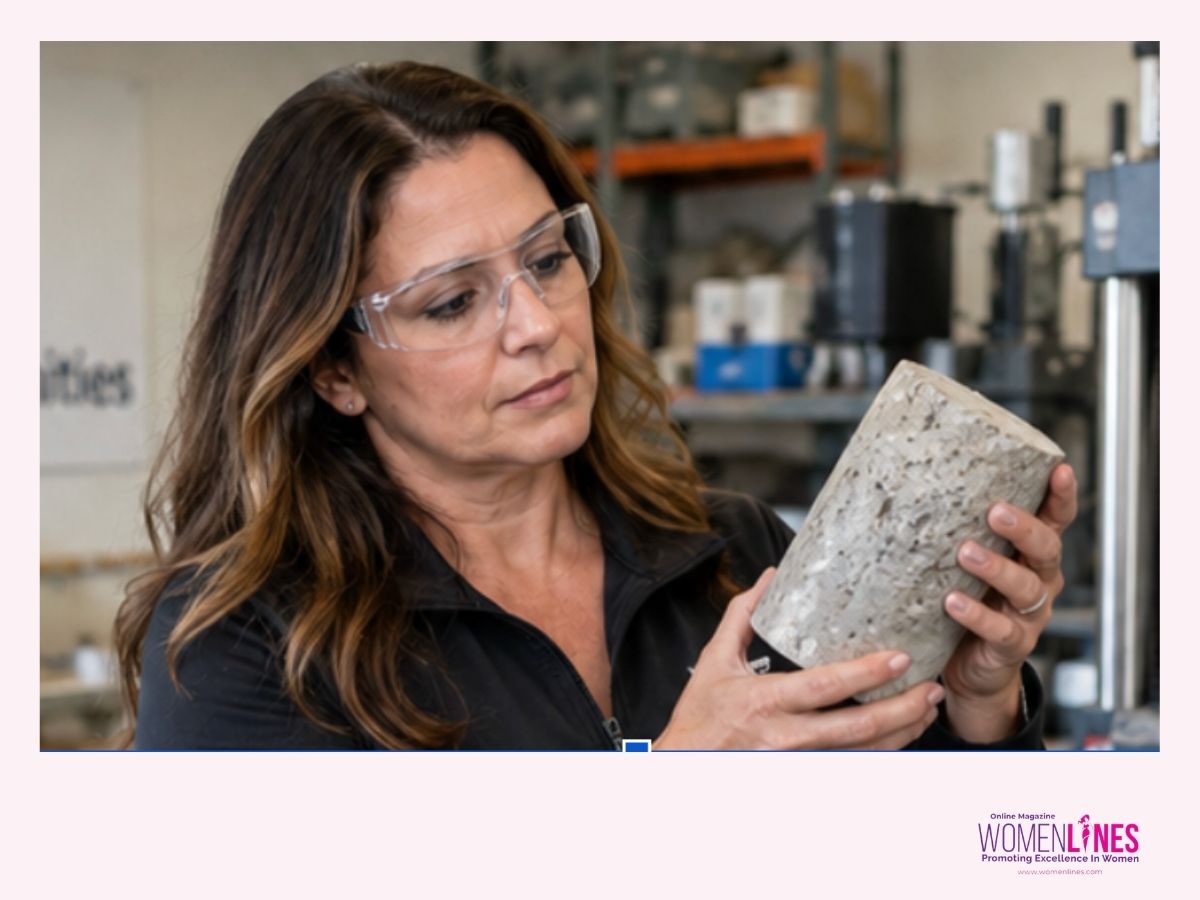
I sell testing equipment for a living, and along the way, I’ve learned some of my most valuable lessons in leadership. Sieves, compaction molds, compressive strength testing machines, moisture probes, the stuff that tells an engineer whether the concrete under a bridge or the soil under a housing development can actually hold up. Most people outside the industry never think about this corner of construction at all, and honestly, before I started Certified MTP, I didn’t either, not in any real depth. I knew it was technical and I knew it was dominated by men, and I figured out pretty fast that almost nobody walking into a room expected a woman to know what ASTM D698 was, let alone why it mattered..
We’re fifteen-plus years in now. Certified MTP carries somewhere north of 57,000 products, works with over 100 suppliers around the country, and has shipped to something like 30,000 customers at this point, maybe more, I’d have to check the exact number. I bring that up not to brag but because looking at it now makes the road look a lot smoother than it actually was. There wasn’t a clean upward line. There were a lot of small, kind of boring decisions, made over and over for years, that only add up to something when you look back at them all at once.
-
Nobody hands you credibility in this industry
The first wall I ran into wasn’t financial. It wasn’t even really operational. It was simpler than that and somehow harder to fix, which is that people just didn’t believe I knew the material. You get on a call about AASHTO compliance or sieve analysis and you’re being tested the whole time whether the other person admits it or not. I remember, early on, sitting in meetings where a lab manager would look past me and direct every technical question to whatever man happened to be standing nearby, even in cases where I was the one who actually knew the answer and the guy next to me didn’t.
So I did the obvious, unglamorous thing, which was just read everything. I learned the standards line by line. I learned what a Blaine air permeability test measures and why a lab would even care. I started asking the kind of questions that made it pretty clear, without me having to say it out loud, that I wasn’t just there to move product for somebody else’s commission. I don’t know a shortcut around that part. You either put in the hours or people keep double-checking your answer behind your back.
It did shift, eventually, though slower than I wanted. Customers who used to explain basic terminology to me like I was new started calling instead to ask what I thought before they bought something. Nobody throws a party for that kind of change. It just quietly becomes normal, and one day you notice it’s been normal for a while.
-
Growth wasn’t a straight line!
We started in 2010. If you only look at where the company sits today it’s easy to assume there was some master plan behind it, and there really wasn’t, not in the way people picture when they hear “business plan.” A lot of what actually drove growth came out of solving boring logistics problems, the kind that never make it into a pitch deck.
Shipping is a good example. When a lab is waiting on a slump cone or a soil compactor to hit a project deadline, a delay isn’t just annoying, it can hold up an entire construction schedule, and somebody above that lab manager is going to want to know why. Getting delivery reliable across the lower 48 took years of trial and error with different suppliers. Some of those relationships fell apart. A few of them are still going strong, more than a decade later, longer than some marriages I know of, honestly.
Turning things down mattered about as much as saying yes to things. Getting the catalog past 57,000 items sounds impressive until you realize the actual hard part was refusing product lines that didn’t meet ASTM or AASHTO standards even when they were cheaper, or when a supplier was leaning on us pretty hard to just take the deal. Without that filter you just end up with clutter, and in an industry where the whole point is accuracy, clutter is basically the opposite of what you’re selling.
There’s a version of growth nobody really talks about, which is the internal, invisible stuff. Tracking inventory across tens of thousands of SKUs from over a hundred suppliers is not glamorous work at all, and if you get it wrong you either overpromise to a customer or you end up sitting on dead stock that ties up money you needed somewhere else. We rebuilt that backend system more than once over the years, and every single rebuild traces back to some specific failure. A shipment we told a customer would be ready and wasn’t. A product listed as in stock that, it turned out, was not actually in stock. Those moments were embarrassing at the time. Looking back, they were probably the most useful thing that happened to us.
One moment I still think about: a few years in, we almost picked up a lower-cost thermometer line because a supplier pushed hard for it and the margins looked good on paper, genuinely good, better than most of what we were carrying at the time. Someone on my team dug into the calibration documentation on it and flagged that it didn’t really hold up next to the rest of our catalog. So we walked away from the deal, and honestly the supplier wasn’t thrilled about it. Nobody outside the company ever found out that happened, there was no announcement, no customer ever asked. It just sat there as one more quiet decision that, looking back, probably mattered more than a lot of the loud ones.
-
Being underestimated taught me more than being believed did
I won’t pretend it didn’t bother me. Especially early on. There was a stretch of a few years where someone would ask, more than once, to “speak to the owner” while I was the one standing right in front of them, arms crossed, waiting. It still happens now and then, less often, but it happens. At some point, I couldn’t tell you exactly when, I started treating it more like information than an insult. When someone underestimates you they’re basically showing you what they assume, and that’s useful, because now you know exactly what you have to demonstrate instead of argue about.
Authority in a technical field doesn’t come from just announcing it. You can’t tell someone “trust me, I know soil testing equipment” and expect that to land on its own. It comes from being consistent for long enough that the consistency becomes the reputation on its own, without you having to push it. That’s a slower path than some people want to take. I’ve watched other leaders try to shortcut it, and it tends to fall apart the first time somebody actually tests them.
Something else I learned, later than I’d like to admit, is that running a women-owned business doesn’t mean I have to personally do everything to prove some kind of point. Some of our strongest supplier relationships, the ones with Gilson, with Ohaus, with a few others, were built by people on my team, not by me sitting across the table. I’ve come around to thinking real leadership isn’t being the only expert in the room. It’s building a room full of people who can hold the standard even when you’re not there to check on them.
-
Resilience, mostly, is boring
I hear a lot of talk about resilience being some single dramatic moment you survive, then turn into a story you tell at a conference years later with a nice arc to it. Mine didn’t really go that way, or if it did, I missed the moment, because it mostly just felt like the fortieth phone call explaining to a skeptical customer why a piece of equipment actually meets spec, or rebuilding a supplier relationship after a shipment falls apart two weeks before somebody’s deadline, or just holding a quality standard on a day when cutting a corner would’ve been faster and nobody would’ve noticed right away.
We’ve never compromised on the reliability of what we sell, mostly because this equipment gets used to verify whether a structure is actually safe to build. That’s not a marketing line, it’s just true, and it’s shaped which suppliers we work with a lot more than price has. If I’m honest, resilience for me has mostly just meant holding that line on the days nobody was watching. Eventually somebody always is watching, even if it takes a while.
-
What I’d tell another woman starting out in a field like this
Honestly, the first thing is just to learn the field well enough that nobody can wave you off with a piece of jargon you haven’t looked up yet, because that happens more than you’d think and it’s an easy trap to fall into if you let it. The growth curve is not going to be smooth, mine wasn’t, so build things that can take a hit without you panicking every time there’s a dip in it. Being underestimated stings less once you start using it as information rather than taking it personally, though I won’t lie and say it stops stinging entirely. And try not to fall into the habit of being the only expert in your own company. It feels safer in the short run. It doesn’t scale, and it’ll wear you down faster than you expect.
Running Certified MTP for over fifteen years now, the thing I keep coming back to is that a women-owned business in a technical field doesn’t need to be the loudest voice in the room to belong there. It needs to be the one people can actually rely on. That’s really the whole lesson, if I had to boil it down. Everything else I’ve written here is just the long way of getting to that same point.

About the Author: Lenea Morrison is the CEO and Owner of Certified MTP, a women-owned business specializing in construction materials testing equipment and laboratory solutions. With more than 15 years in the industry, she brings firsthand experience in entrepreneurship, technical leadership, and building a business in a traditionally male-dominated field
Commercial Partnership: This content has been published in collaboration with a Womenlines partner.
Also read:How Local Businesses Can Build a Strong Online Reputation from Offline Success
Follow Womenlines on Social Media