
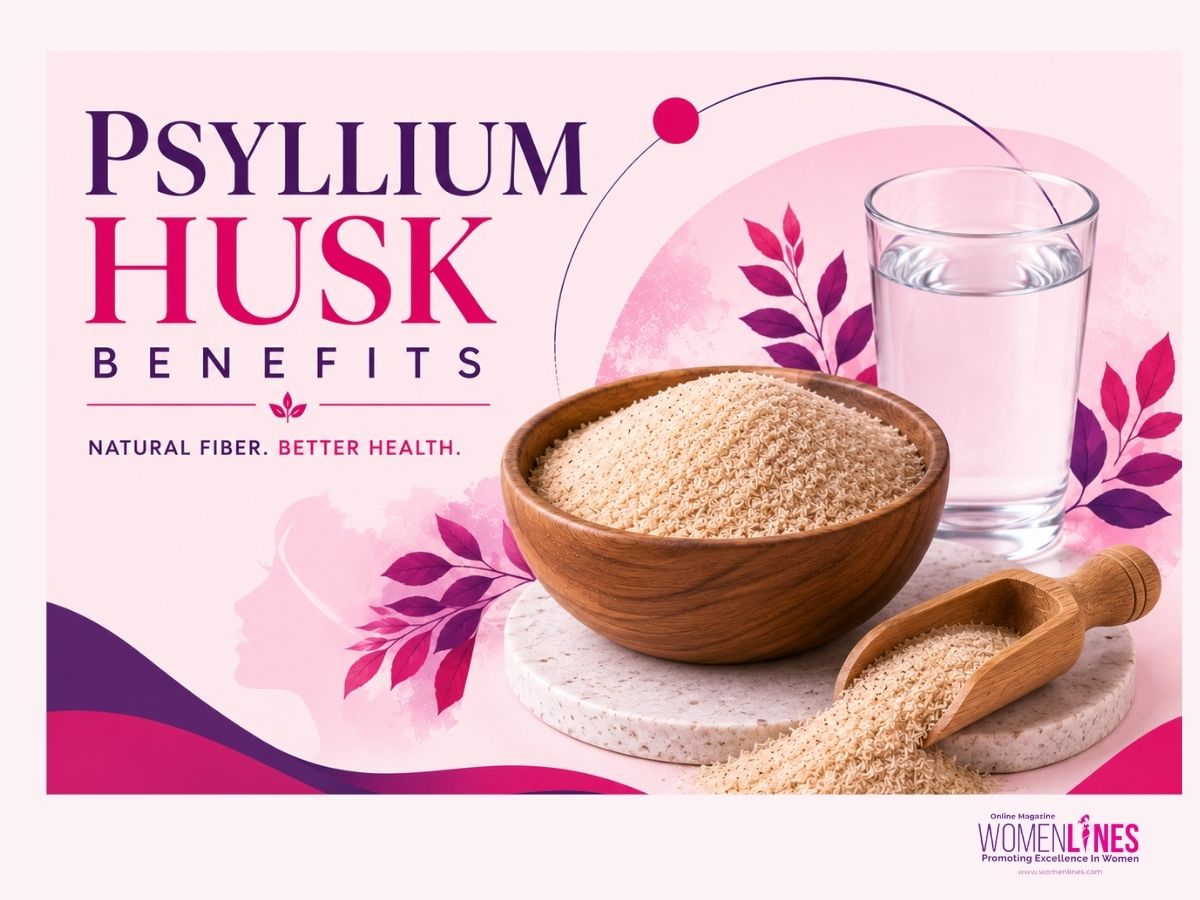
Psyllium husk benefits are suddenly everywhere in the wellness world. Try scrolling through wellness content for five minutes and you will find someone stirring a spoonful of pale powder into water, drinking it in one shot, and captioning it “the one supplement everyone needs.”
Psyllium husk is one of those products that has gone from our grandma’s medicine cabinet to wellness-cult status, pretty much overnight. Suddenly, this humble fiber supplement is being recommended for everything from constipation and bloating to blood sugar, weight loss, PCOS and gut health.
So how much of that reputation is earned vs. hype? Let’s find out.
First, What Exactly Is Psyllium Husk?
Psyllium husk comes from the seeds of Plantago ovata, a plant grown mainly in India and parts of the Mediterranean.
Its claim to fame is that it can hold up to ~40 times its weight in water. This means that when the husk meets water, it swells into a thick, viscous gel. And that gel is the open secret behind its glory: it adds bulk and moisture to stool, slows digestion and nutrient absorption, and can help keep you feeling fuller for longer.
It is not new. It has been used medicinally for centuries and has been studied in clinical trials since the 1980s.
What is new is the PR budget.
After all, the fairly unglamorous husk India has been eating for generations is now available worldwide as powders, capsules, sachets, wafers, gummies and even flavoured drinks!
What Does Science Actually Say?
1. Constipation: This Is Where Psyllium Really Shines
An updated 2022 meta-analysis looked at 16 trials and found that fiber supplementation helped 66 percent of people with chronic constipation, compared with 41 percent on placebo, and psyllium specifically came out as the most effective fiber type studied.
At adequate doses, it increased bowel movements by roughly three a week, putting it in the same range of effectiveness as some over-the-counter laxatives, but working mechanically rather than by stimulating the gut.
So yes, if constipation is your problem, psyllium can be a very reasonable tool.
But here is the part that often gets lost:
You don’t necessarily need a supplement to start improving your fiber intake.
Fruit, vegetables, whole grains, beans, lentils, nuts and seeds all contribute fiber too.
In fact, a 2023 systematic review looking specifically at foods and dietary approaches for chronic constipation found that some fruits, including kiwifruit, performed at least as well as psyllium for certain constipation outcomes.
Your gut does not know whether your fiber came with a wellness label. It just knows that it needs fiber.
2. Cholesterol: A Modest but Meaningful Benefit
Psyllium also has a respectable evidence base for cholesterol.
A 2000 meta-analysis in the American Journal of Clinical Nutrition pooled eight controlled trials and found that 10.2 g of psyllium per day, added to a low-fat diet, reduced total cholesterol by about 4% and LDL cholesterol by about 7%.
A larger, more recent analysis in 2018, pooling 28 randomized trials and nearly 1,900 participants, confirmed the direction of that effect: psyllium significantly reduced LDL cholesterol, along with two other markers doctors track closely, non-HDL cholesterol and apolipoprotein B.
The effect is consistent enough that the US FDA allows a specific health claim on psyllium products: 7 grams of soluble fiber a day from psyllium, alongside a diet low in saturated fat, may reduce the risk of coronary heart disease.
That is a genuinely high bar for a supplement to clear. And psyllium clears it.
More recent research continues to support this direction. A 2025 systematic review and dose-response meta-analysis of 41 randomized controlled trials found significant reductions in LDL and total cholesterol with psyllium supplementation.
That is useful.
But notice the wording:
It is an adjunct.
It works alongside a healthy diet. It isn’t a replacement for one, and it certainly isn’t a substitute for cholesterol-lowering medication when medication has been prescribed.
3. Blood Sugar: Promising, but Not a Diabetes Cure
A 2015 meta-analysis of 35 randomized, controlled trials found that, in people with type 2 diabetes, psyllium taken before meals lowered fasting blood glucose by about 37 mg/dL and HbA1c by nearly one percentage point.
Interestingly, the effect wasn’t uniform. It appeared to increase with baseline blood glucose: people with normal blood sugar saw essentially no fasting-glucose benefit, while those with prediabetes saw a modest effect and those with type 2 diabetes saw the largest reduction.
This is worth paying attention to.
But there is an important distinction between “can improve a marker” and “will fix your metabolic health.”
Blood sugar regulation is influenced by the overall dietary pattern, body composition, physical activity, sleep, genetics, medications and several other factors.
A spoonful of fiber cannot be expected to carry that entire team on its back.
- 4. Gut Microbiome: Some promising signals
Psyllium is a fermentable fiber, so some of it reaches the colon and is metabolized by gut microbes. Studies suggest it can influence the composition and activity of the microbiome and increase the production of short-chain fatty acids.
But this is where the science gets complicated. The gut microbiome isn’t one uniform ecosystem with a simple list of “good” and “bad” bacteria. It contains trillions of microorganisms, representing thousands of species and an enormous diversity of strains, and everyone’s microbial community is different.
So while we have evidence that psyllium can change the microbiome, we cannot confidently say that it will produce the same changes, or the same health benefits, in everyone.
In other words, “psyllium feeds your good gut bacteria” is a catchy Instagram claim. “Psyllium can influence the gut microbiome, and researchers are still working out what those changes mean for different people” is much closer to the science.
And Then There Is Weight Loss…
This is where I would be especially cautious about the internet hype.
Because psyllium can increase fullness, it is tempting to turn it into a weight-loss story.
But the evidence is not nearly as dramatic as social media makes it sound.
A systematic review and dose-response meta-analysis of 22 randomized controlled trials found no significant reduction in body weight, BMI or waist circumference with psyllium supplementation. Other analyses have found no significant effect on weight or BMI at all.
So I would not put psyllium in the “weight-loss supplement” bucket.
If adding fiber helps you feel fuller and makes it easier to follow a nutritious eating pattern, it may indirectly support weight management.
That is very different from saying:
“Take psyllium and lose belly fat.”
What About PCOS, Menopause and “Balancing Hormones”?
This is where the conversation gets particularly interesting for women.
You may see psyllium recommended online for PCOS, estrogen detoxification, menopause, insulin resistance and hormonal balance.
Some of these claims start with a reasonable biological idea and then sprint several kilometers beyond the evidence.
Psyllium can influence blood glucose, insulin-related markers and cholesterol. Those are relevant to metabolic health, including for women with conditions such as PCOS.
But that does not mean psyllium has been established as a treatment for PCOS or menopause.
For example, research on PCOS shows that metabolic health and lifestyle interventions can influence important PCOS outcomes, but the evidence does not translate into “take psyllium to balance your hormones.”
So if you see claims that psyllium “balances estrogen,” “fixes PCOS” or “resets menopause hormones,” pause.
There is a difference between:
“This fiber may support one part of metabolic health.”
and
“This fiber fixes your hormones.”
The first can be evidence-based.
The second is a much bigger claim.
The Bigger Question: Why Are We Supplementing Fiber in the First Place?
This, to me, is the most important part of the conversation.
Fiber is not supposed to live exclusively in a glass of water beside your morning coffee.
It naturally occurs in foods such as vegetables, fruit, whole grains, beans, lentils, nuts and seeds.
And those foods bring much more to the table than fiber.
A bowl of lentils gives you fiber, but also protein, minerals and other plant compounds.
An apple gives you fiber alongside vitamins and polyphenols.
Nuts and seeds bring fiber alongside healthy fats, protein and minerals.
Vegetables bring fiber alongside an enormous variety of micronutrients and plant compounds.
Food is a package deal.
A fiber supplement is not.
That does not make psyllium bad.
It simply puts it in the correct category.
The Samatvam Living Hierarchy: Food First, Supplement “As Needed”
At Samatvam Living, our approach is fairly simple:
Build the plate before you build the supplement stack.
Start with a balanced meal.
Get your vegetables.
Eat your fruit.
Include legumes, whole grains, nuts and seeds regularly.
Make sure you are eating enough protein.
Then look at what is still missing.
If you are consistently falling short on fiber despite a reasonably balanced diet, psyllium can be a practical way to close that gap.
If constipation is an ongoing problem, it may be particularly useful.
If your doctor has recommended additional soluble fiber to support cholesterol or metabolic health, it can be a useful tool there too.
But I think of it as the second-best option, not the first.
Not because supplements are inherently inferior.
Because whole foods give you much more than the isolated nutrient you are trying to add.
What Psyllium Cannot Do
It cannot turn a highly processed diet into a nutritious one.
It cannot compensate for a lack of vegetables.
It cannot replace physical activity.
It cannot fix chronic sleep deprivation.
It cannot “detox” your hormones.
It cannot melt abdominal fat.
And it cannot make an unbalanced diet balanced simply because you drank a glass of fiber before dinner.
That last one may disappoint the algorithm.
I’m okay with that.
If You Want to Use Psyllium, Use It Sensibly
Psyllium absorbs water, so taking it with enough fluid is important.
Taking fiber too quickly or in large amounts can also cause bloating and gas. In clinical trials, higher fiber intake was associated with more flatulence, particularly when doses were increased.
And because psyllium can affect the absorption of some medicines, anyone taking regular medication should check with their doctor or pharmacist about appropriate timing.
In other words:
More fiber is not automatically better fiber.
So, Should You Take Psyllium?
Maybe. But answer these first:
- Am I getting enough fiber from my daily meals?
Look at your actual plate, not your intentions.
- Is there a specific reason I think I need more?
Constipation? Consistently low fiber intake? A recommendation from your healthcare professional for cholesterol or metabolic health?
- Am I using it to supplement my diet or to compensate for it?
That third question is the big one.
Because psyllium is a useful tool.
It just isn’t a nutritional foundation.
The Bottom Line
Psyllium husk deserves neither the pedestal nor the backlash.
It is a well-studied source of soluble fiber with legitimate benefits for bowel regularity, and evidence supporting modest improvements in cholesterol and some measures of blood sugar control.
That is already pretty impressive.
We don’t need to turn it into a miracle.
At Samatvam Living, the philosophy is simple:
Eat the balanced plate first.
Get your fiber from vegetables, fruits, legumes, whole grains, nuts and seeds.
And if life, appetite, travel, convenience or a specific health need means you still have a gap (most women need 25–30 g of fiber per day), psyllium can help fill it.
Think of it as a useful tool in the toolbox.
Not the toolbox itself.
About the Author

Deepti Agrawal spends her days building environments that make healthy living easier, closing the gap between knowing what’s good for you and actually doing it.
She is co-founder of Samatvam Living, a Singapore-based lifestyle coaching company she started after two decades in the corporate world. She works with clients through 1:1 coaching, corporate workshops and community events.
She is a NASM-certified nutrition coach and holds a Yoga Shiromani from Sivananda Ashram, India.
More at www.samatvam.living and @samatvam.living.
References
- Van der Schoot A, Drysdale C, Whelan K, Dimidi E. The effect of fiber supplementation on chronic constipation in adults: an updated systematic review and meta-analysis of randomized controlled trials. Am J Clin Nutr. 2022;116(4):953–969.
- Wilson B, et al. Systematic review and meta-analysis: foods, drinks and diets and their effect on chronic constipation in adults. Aliment Pharmacol Ther. 2023.
- Anderson JW, Allgood LD, Lawrence A, et al. Cholesterol-lowering effects of psyllium intake adjunctive to diet therapy in men and women with hypercholesterolemia: meta-analysis of 8 controlled trials. Am J Clin Nutr. 2000;71(2):472–479.
- Jovanovski E, Yashpal S, Komishon A, et al. Effect of psyllium (Plantago ovata) fiber on LDL cholesterol and alternative lipid targets, non-HDL cholesterol and apolipoprotein B: a systematic review and meta-analysis of randomized controlled trials. Am J Clin Nutr. 2018;108(5):922–932.
- US Food and Drug Administration. Food labeling: health claims; soluble fiber from certain foods and coronary heart disease. 21 CFR 101.81.
- Genes & Nutrition. Psyllium supplementation and lipid profiles: systematic review and dose-response meta-analysis of randomized controlled trials. 2025. 41 RCTs, 2,049 participants.
- Gibb RD, McRorie JW Jr, Russell DA, Hasselblad V, D’Alessio DA. Psyllium fiber improves glycemic control proportional to loss of glycemic control: a meta-analysis of data in euglycemic subjects, patients at risk of type 2 diabetes mellitus, and patients being treated for type 2 diabetes mellitus. Am J Clin Nutr. 2015;102(6):1604–1614.
- Darooghegi Mofrad M, Mozaffari H, Mousavi SM, Sheikhi A, Milajerdi A. The effects of psyllium supplementation on body weight, body mass index and waist circumference in adults: a systematic review and dose-response meta-analysis of randomized controlled trials. Crit Rev Food Sci Nutr. 2020;60(5):859–872.
Frequently Asked Questions About Psyllium Husk
1. What are the main benefits of psyllium husk?
Psyllium husk is a well-studied source of soluble fiber. Evidence supports its use for bowel regularity and constipation, with additional evidence showing modest improvements in cholesterol and some measures of blood sugar control.
2. Is psyllium husk good for constipation?
Yes. This is where psyllium has some of its strongest evidence. An updated 2022 meta-analysis found fiber supplementation helped people with chronic constipation, with psyllium emerging as the most effective fiber type studied.
3. Can psyllium husk help lower cholesterol?
Psyllium may help modestly lower cholesterol when used alongside a healthy diet. Research cited in the article found reductions in LDL cholesterol, and the US FDA allows a specific heart-health claim for soluble fiber from psyllium when consumed as part of a diet low in saturated fat. It should be viewed as an adjunct rather than a replacement for a healthy diet or prescribed cholesterol medication.
4. Does psyllium husk help with weight loss?
The evidence does not support treating psyllium as a weight-loss supplement. Although psyllium may increase feelings of fullness, a systematic review cited in the article found no significant reduction in body weight, BMI or waist circumference. It may indirectly support weight management if additional fiber makes it easier to follow a nutritious eating pattern.
5. Is psyllium husk good for gut health?
Psyllium is a fermentable fiber and can influence the composition and activity of the gut microbiome. However, everyone’s microbiome is different, and researchers are still working out what these changes mean for different people.
6. Can psyllium husk help control blood sugar?
Research suggests psyllium may improve some measures of blood sugar control, particularly in people with type 2 diabetes. However, it is not a diabetes cure. Blood sugar regulation is affected by many factors, including diet, physical activity, sleep, body composition, genetics and medications.
7. Does psyllium husk help with PCOS or balance hormones?
Psyllium can influence blood glucose, insulin-related markers and cholesterol, which are relevant to metabolic health. However, this does not mean that psyllium is an established treatment for PCOS or menopause, or that it can “balance” hormones.
8. Is it better to get fiber from food or psyllium husk?
The article recommends a food-first approach. Vegetables, fruits, whole grains, beans, lentils, nuts and seeds provide fiber together with other nutrients and plant compounds. Psyllium can be useful when dietary fiber is still insufficient or when there is a specific reason for adding soluble fiber.
9. How should you take psyllium husk safely?
Psyllium absorbs water, so adequate fluid intake is important. Increasing fiber too quickly or taking large amounts may cause bloating and gas. Because psyllium can also affect the absorption of some medicines, people taking regular medication should check appropriate timing with their doctor or pharmacist.
10. Should you take psyllium husk every day?
The article recommends first considering whether you are already getting enough fiber from your meals and why you want additional fiber. Psyllium can be a useful tool for consistently low fiber intake, ongoing constipation or when additional soluble fiber has been recommended by a healthcare professional.
11. How much fiber do women need per day?
The article notes that most women need around 25–30 grams of fiber per day. The preferred approach is to get fiber from vegetables, fruits, legumes, whole grains, nuts and seeds first, with psyllium helping to fill a remaining gap when needed.
Also read:The Early Breast Changes Too Many Women Brush Off
Follow Womenlines on Social Media