
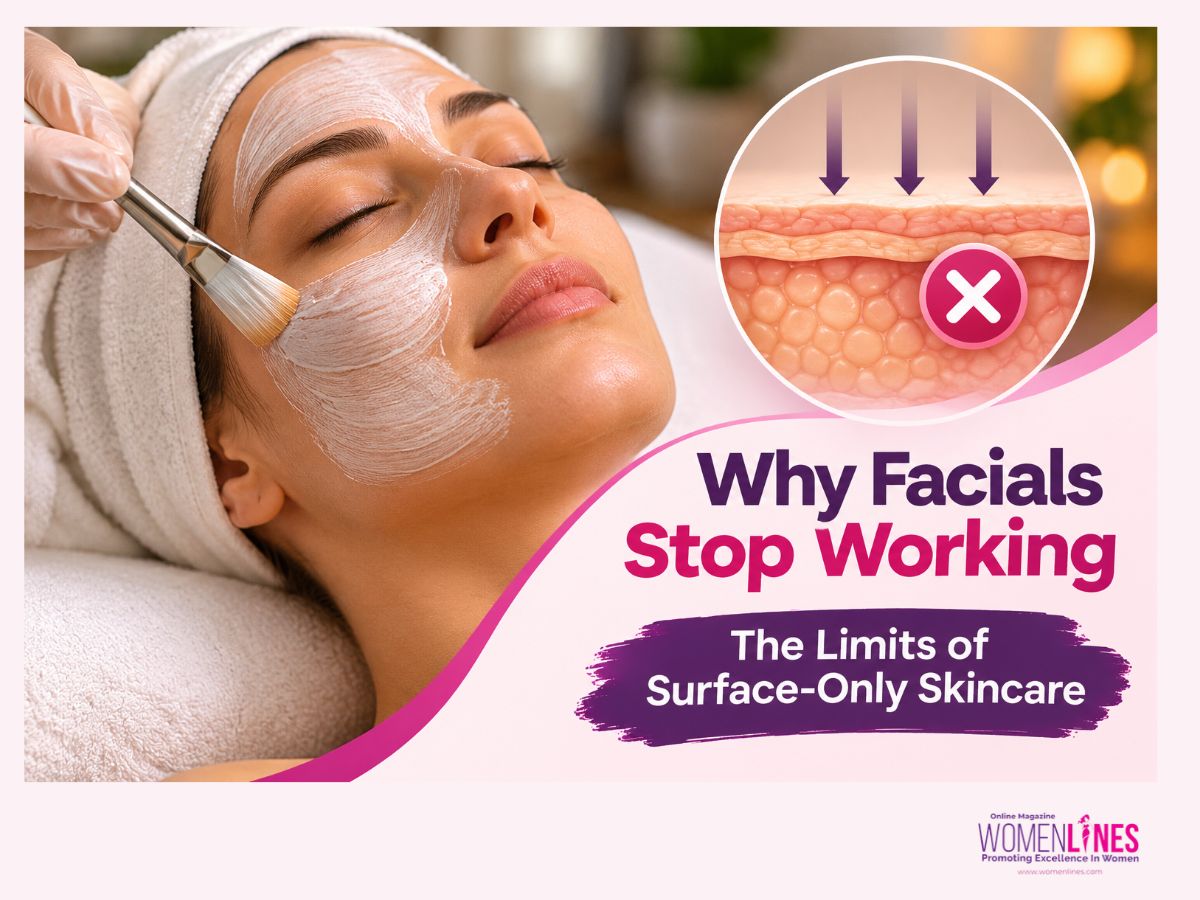
You book your monthly facial treatment, indulge in rejuvenating spa facials, and leave glowing. For a few days, your skin looks the best it has in weeks.
Then, slowly, the same old concerns creep back: the patch of pigmentation on your cheek, the fine lines around your eyes, the softness along your jawline that wasn’t there five years ago.
If this cycle sounds familiar, you’re not doing anything wrong, and neither is your facialist. The problem is structural. Most facials are designed to treat the surface of the skin, while many of the concerns women care about most start much deeper. Understanding that difference is the first step to choosing skincare that actually moves the needle.
What a Facial Actually Does (and Does Well)
A good facial is genuinely beneficial. Depending on the type, it can:
- Deep-cleanse pores and remove built-up oil, sunscreen and pollution residue
- Exfoliate dead skin cells, which instantly makes skin look brighter and smoother
- Clear congestion through extractions
- Hydrate the outermost layer, giving that plump, dewy look
- Boost circulation through massage, which temporarily improves colour and reduces puffiness
- Help you relax, which, for busy working women, is not a small thing
Notice what all of these have in common: they work on the epidermis, the thin top layer of your skin. That’s why the results are visible almost immediately, and also why they fade.
Your Skin Has Layers, and Most Concerns Live Below the Surface
Skin is not a single sheet. It’s a layered structure, and each layer is responsible for different things you see in the mirror.
| Layer | What it controls | Common concerns that start here |
|---|---|---|
| Epidermis (surface) | Tone, texture, clarity, hydration | Dullness, rough texture, surface congestion, superficial pigmentation |
| Dermis (middle) | Firmness and elasticity, through collagen and elastin | Fine lines, wrinkles, enlarged pores, acne scars, deeper pigmentation |
| Deeper support structures (fat, muscle layer, bone) | Volume, lift and facial contour | Sagging, hollowness, loss of jawline definition |
A facial can make the epidermis look its best. But it can’t rebuild collagen in the dermis, fade pigment sitting deeper in the skin, or restore the support structures that hold your face up. That’s the ceiling every surface-only routine eventually hits.
5 Reasons Your Facials Have Stopped Working
1. Your skin’s barrier is designed to keep things out
The outermost layer of skin, the stratum corneum, exists to protect you. It blocks most large molecules from passing through, which is excellent for keeping out irritants but limits how deeply many serums, masks and ampoules applied during a facial can travel. Ingredients may hydrate and soften the surface without reaching the layer where the problem is.
2. Your pigmentation is deeper than it looks
Pigmentation can sit in the epidermis, the dermis, or both. Superficial spots often lighten with exfoliation and brightening products. Deeper pigment, including some forms of melasma, which is common in Asian skin, tends to return because surface treatments don’t address where the pigment is produced or deposited. If your dark patches fade after a facial and come back within weeks, depth is a likely reason.
3. Collagen loss is happening in the dermis
From our mid-20s onwards, the body gradually produces less collagen, and sun exposure, stress, poor sleep and hormonal changes accelerate the decline. Fine lines, crepey texture and a loss of “bounce” are signs of change in the dermis. A facial can temporarily plump the surface with hydration, but it doesn’t meaningfully stimulate new collagen where it’s needed.
4. Sagging comes from the foundation, not the façade
When skin starts to sag, it’s tempting to blame the skin itself. In reality, facial ageing involves changes beneath it: fat pads shift and thin, the supportive muscle layer loosens, and even facial bone gradually remodels. Think of it like a tent whose poles are shortening. No amount of polishing the fabric will lift it back up.
5. Acne scars are structural damage
Indented acne scars form when inflammation damages collagen in the dermis. Facials can calm active breakouts and improve surface texture, but they can’t remodel the scar tissue underneath. That requires treatments that work at the depth where the scar was formed.
Signs You’ve Hit the Surface-Only Ceiling
You may have outgrown a facial-only routine if:
- Your skin looks great for 3 to 5 days after a facial, then returns to baseline
- Pigmentation lightens and returns, especially after sun exposure
- You’re increasing the frequency of facials but not seeing more improvement
- Your main concerns are firmness, lines, scars or sagging rather than dullness or congestion
- You’ve tried multiple “upgraded” facials and products with similar results
None of this means facials are a waste. It means they’re one tool, best suited to surface maintenance, being asked to solve problems outside their reach.
What a Multi-Layered Approach Looks Like
The alternative isn’t simply “a stronger treatment.” It’s a different way of thinking: identify which layer each concern comes from, then treat each layer with an appropriate method, in the right sequence. In medical aesthetics, this is often described as a multi-layered approach.
A typical multi-layered plan follows four steps:
- Understand your skin. A doctor’s consultation covering your concerns, skin history, lifestyle and goals.
- Map the layers. A skin and facial analysis to determine whether each concern is surface-level, dermal or structural.
- Build the plan. A personalised roadmap that may combine treatments targeting different depths, rather than one treatment for everything.
- Maintain the result. Progress reviews and a maintenance schedule, which is often where facials and good home care still play a valuable role.
Within that plan, treatments are chosen by the layer they reach:
- Surface (epidermis): medical-grade facials, chemical peels and certain lasers to improve tone, texture and superficial pigmentation
- Middle (dermis): pigment lasers, microneedling with radiofrequency and injectable skin boosters to support collagen, firmness, scars and deeper pigmentation
- Deep (support structures): energy-based lifting treatments such as focused ultrasound, and volume-restoring injectables to address contour and sagging
The value isn’t in any single treatment. It’s in matching the right method to the right layer, so each step builds on the last instead of repeating the same surface work.
Facials vs a Multi-Layered Plan: A Quick Comparison
| Surface-only facials | Multi-layered approach | |
|---|---|---|
| Depth treated | Epidermis | Epidermis, dermis and deeper support structures |
| Best for | Glow, hydration, congestion, relaxation | Pigmentation, firmness, lines, scars, sagging |
| How results build | Visible quickly, fade within days to weeks | Develop gradually as the skin rebuilds |
| Who designs it | Beautician or facialist | Doctor, based on a skin assessment |
| Role over time | Ongoing maintenance | Correction and prevention, supported by maintenance |
How to Choose a Clinic for Layered Skin Treatment
If you’re ready to look beyond the surface, the clinic you choose matters as much as the treatment. Ask these questions before committing:
- Is the treatment plan designed by a doctor? Layer-specific treatments, especially energy devices and injectables, should be assessed and performed under medical supervision.
- Do they assess before they sell? A proper consultation and skin analysis should come before any package recommendation.
- Can they explain which layer each treatment targets? If the answer is vague, the plan probably is too.
- Is the plan personalised? Be cautious of one-size-fits-all packages that give everyone the same treatment.
- Do they plan for maintenance? Good results are built over time and need a realistic follow-up schedule.
For women in Singapore weighing their options, a doctor-led, multi-layered aesthetic clinic treatment plan is worth considering when facials alone have stopped delivering. Clinics such as Innerskin in Novena build their approach around this idea, assessing the skin layer by layer before recommending treatment, on the principle that better skin is built rather than simply corrected.
Should You Stop Getting Facials?
Not necessarily. Facials remain a useful part of a skincare routine, especially for cleansing, hydration and maintaining results. The shift is in expectation: treat facials as maintenance for the surface, not as a solution for concerns that start deeper. Used alongside a layered treatment plan, they can help keep skin healthy between clinical sessions.
Frequently Asked Questions
Why does my skin look good after a facial but go back to normal in a few days?
Facials mainly hydrate and exfoliate the outermost skin layer. These effects are real but temporary, as the skin naturally sheds and loses that surface hydration. Concerns rooted in deeper layers remain unchanged.
Can facials remove pigmentation?
Facials with exfoliation and brightening products can help superficial pigmentation. Deeper pigmentation, including some types of melasma, usually needs a doctor’s assessment and treatments that reach the dermis.
What is a multi-layered skin treatment?
It’s an approach that identifies which skin layer each concern comes from (surface, dermis or deeper support structures) and combines treatments that target each layer, instead of relying on a single surface treatment.
At what age should I consider treatments beyond facials?
There’s no fixed age. Many women start considering layered treatments in their late 20s to 30s, when collagen decline becomes noticeable, but the right time depends on your concerns, not your birthday.
Are layered aesthetic treatments safe?
When assessed and performed by qualified doctors, with a plan suited to your skin type and medical history, they are generally well tolerated. Always ask about downtime, possible side effects and suitability during your consultation.
This article is for general information only and does not replace a medical consultation. Results vary between individuals.
Commercial Partnership: This content has been published in collaboration with a Womenlines partner.
Also read:Streamline Your Business: Tools for Modern Founders
Follow Womenlines on Social Media