
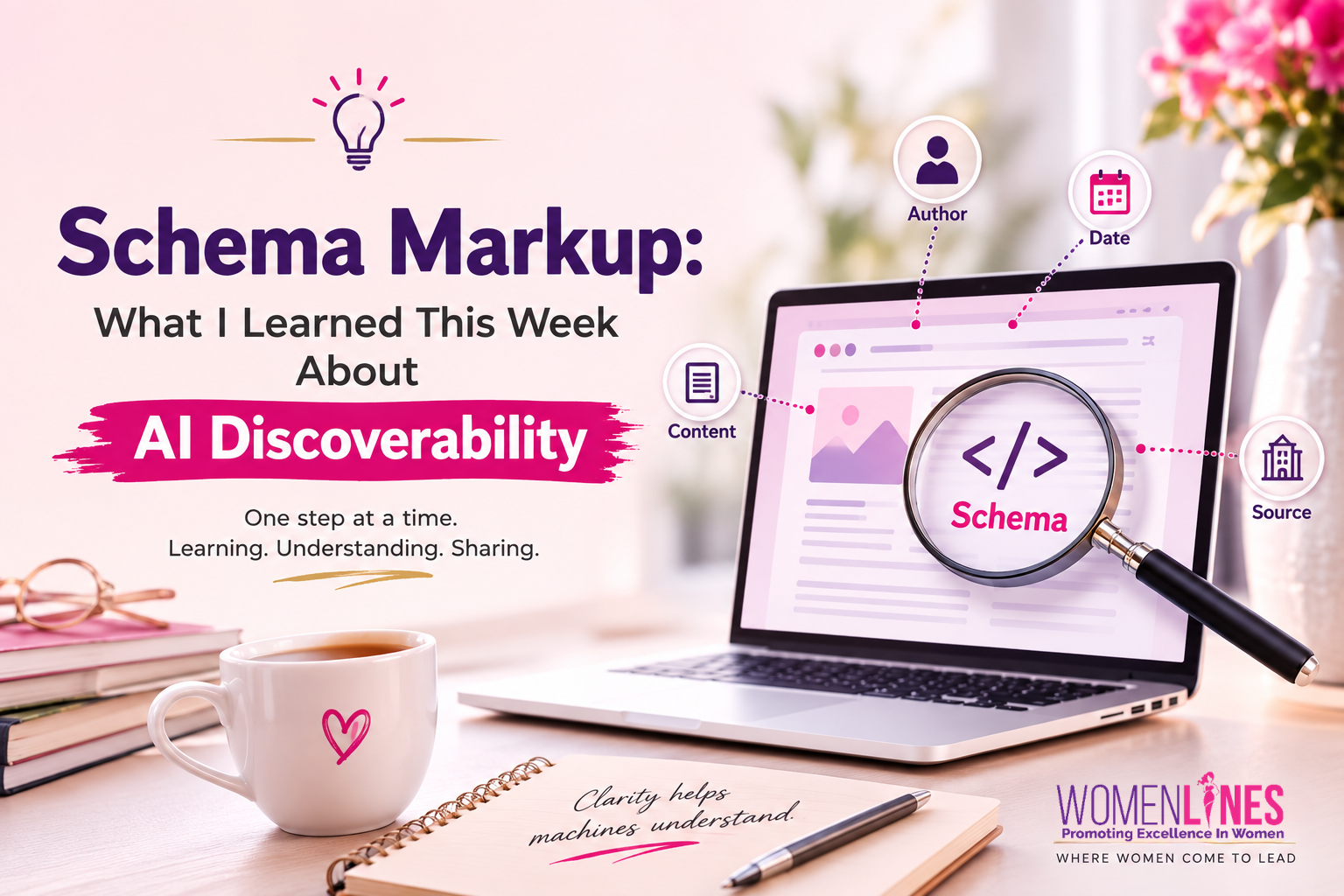
Every week, I’m learning something new about how AI discoverability actually works. and this week is about schema markup role in AI discoverability
I don’t come from a tech background, so I take it slowly—one concept at a time, trying to really understand it before moving to the next.
This week, the word that kept showing up was “schema.”
At first, it sounded technical and a little intimidating. But I told myself: let me sit with this and understand it simply, in my own words.
And once I did, I realised the basic idea is actually quite simple.
So, what is schema really?
A webpage is easy for us humans to understand.
We see a headline, photograph, author’s name, publication date, product, price or video, and we naturally understand what each piece of information represents.
Machines need more structure.
Schema markup is a standardised way of giving search engines structured information about the content and entities on a webpage.
Think of it like introducing yourself when you walk into a room.
You might say:
This is my name. This is what I do. This is the organisation I represent.
Schema does something similar for web content—but in a structured vocabulary that machines can process.
So rather than thinking of schema as some mysterious SEO technique, I’m beginning to think of it as one way of making information more machine-readable and less ambiguous.
And that distinction became important as I learnt more.
What schema does—and what it doesn’t
This was probably my biggest learning of the week.
Schema is not a magic switch for Google rankings or AI visibility.
Adding schema to a page does not automatically mean that ChatGPT, Google or another AI platform will suddenly recommend, cite or rank that page.
Instead, schema gives machines clearer structured context about information on the page.
For example, it can help identify:
-
Who wrote an article
-
Which organisation published it
-
When it was published
-
What a product is
-
What an event is
-
Which video appears on a page
-
How different pages within a website are connected
That may sound like a small technical detail.
But when I think about how much information machines have to process across the web, making important facts explicit instead of leaving everything to interpretation makes a lot of sense to me.
Why does this matter for AI discoverability?
This is where I had to correct one of my own assumptions.
Initially, I thought:
If I add schema, does that mean AI will be more likely to mention my content?
The answer isn’t that simple.
There is no guarantee that adding schema will make an AI platform cite or recommend your website.
What I’m understanding instead is that AI discoverability is a much bigger ecosystem.
It can involve things such as:
Useful, original content Crawlability Clear authorship and publishing information Consistent information about your brand across the web Credible external mentions and backlinks Strong website structure Up-to-date information where freshness matters Machine-readable information, including structured data
Schema belongs inside that larger picture.
It doesn’t replace good content, authority or credibility.
It helps make parts of that information clearer to machines.
That feels like a much more realistic way to look at it.
One discovery that really interested me
While learning about schema, I discovered something even more fundamental.
Before worrying about whether an AI system understands your website, there is another question:
Can it access your content in the first place?
For example, OpenAI currently provides publishers with guidance around OAI-SearchBot, the crawler used for surfacing websites in ChatGPT search.
That was another little light-bulb moment for me.
We talk so much about “optimising for AI,” but sometimes the starting point is much simpler:
Can search and AI systems access the information? Can they understand what it represents? Can they clearly connect it to the right person, organisation and topic?
Only after that does optimisation really begin to make sense.
Think of schema as a small label added behind a webpage that helps Google and other search engines understand exactly what the page is about. We create the webpage for people, while schema explains its meaning to machines. For example, if we publish an article, schema can tell Google its headline, author, publication date, image and publisher. Different pages can use different schema types, such as Article, Organization, Person, Event or VideoObject.
The process is actually quite simple, especially on WordPress. First, identify what type of content the page contains and choose the appropriate schema. SEO plugins such as Yoast SEO or Rank Math can automatically generate much of the required schema, so you usually don’t need to write the code yourself. Once the correct information is added, publish or update the page and enter its URL into Google’s Rich Results Test to check whether Google can understand the structured data and whether there are any errors that need fixing. In simple terms:
Choose the page type ? Add the right schema ? Publish ? Test with Google ? Fix any errors
What schema can practically help with
Learning about schema helped me understand several practical benefits.
1. Give search engines clearer information
Schema can explicitly describe important information about a page rather than requiring systems to infer everything from visible text.
2. Make eligible pages suitable for certain enhanced search results
For supported content types, structured data can make a page eligible for enhanced Google search appearances.
The important word here is eligible.
Adding structured data does not guarantee that Google will show a rich result.
3. Clarify relationships between entities
Structured data can help describe relationships between a person, an organisation, an article, a video or other entities.
For a publishing platform, I find this particularly interesting.
4. Create cleaner machine-readable context
As search evolves beyond traditional blue links, having clearly structured information feels like a sensible foundation—even though schema alone does not guarantee AI visibility.
Real examples that helped me understand schema
Once I understood the “what,” I wanted examples that made the concept tangible.
A recipe website
A recipe page can use Recipe structured data to identify information such as cooking time, ingredients and other recipe details.
For eligible pages, Google may use structured information to create enhanced search experiences.
The important lesson for me:
Schema describes the information—it doesn’t guarantee the search result.
An e-commerce product page
A product page can use Product structured data to describe information such as the product, price, availability, offers and ratings where applicable.
Again, this gives search systems structured information they may use when presenting eligible product results.
A media article
A publication can use Article structured data to identify information such as:
Headline Author Publication date Publisher
This doesn’t mean an AI platform will automatically cite the article.
But it provides structured context about what the content is, who created it and who published it.
For Womenlines, this is particularly relevant.
A business website
An organisation can use Organization structured data to provide information such as its name, logo and other organisational details.
It isn’t about forcing a search engine or AI system to describe the business in a particular way.
It is about giving machines another structured source of information about the entity.
A mistake I nearly made
I initially started mixing several good website practices together and calling all of them “schema.”
They’re not.
Things such as:
Clean URLs Clear headings Useful page structure Regular content updates Internal linking
are all valuable website and SEO practices.
But they are not schema markup.
Schema is specifically structured data added to help describe the meaning of information.
Understanding this difference helped make the whole subject much clearer for me..
How I’m keeping this simple for myself
My approach now is:
1. Identify what the page actually represents.
Is it an article? A person? An organisation? A video? A product?
2. Choose the appropriate structured-data type.
Don’t add schema simply because someone says it’s “good for SEO.”
3. Keep structured data consistent with visible content.
The information we’re giving machines should accurately reflect what visitors can actually see on the page.
4. Test it.
Use available validation tools to identify errors or missing recommended information.
5. Keep learning.
Search and AI discovery are changing quickly. What matters today may evolve tomorrow.
My biggest takeaway this week
I started the week thinking schema might be another secret ingredient for getting discovered by AI.
I’m ending the week with a different understanding.
There probably isn’t one secret ingredient.
AI discoverability seems to be about building many signals that work together:
Great content.
Clear expertise.
Credible mentions.
Quality backlinks.
Consistent brand information.
Technical accessibility.
And yes—structured, machine-readable information.
Schema is one piece of that puzzle.
And perhaps that’s the bigger lesson I’m taking away from this entire learning journey:
We shouldn’t be trying to trick machines into discovering us.
We should be making it easier for both people and machines to understand who we are, what we know and why our information deserves attention.
So if you’re also learning about AI discoverability one step at a time, schema is certainly worth understanding.
Not because it’s magical.
But because clarity is becoming increasingly important in a world where both humans and machines are trying to make sense of our content.
And that, for me, was this week’s learning.
Charu Mehrotra
Founder Womenlines
This article reflects my personal interpretation and simplification of publicly available data from HubSpot’s 2026 State of Marketing Report. I am not affiliated with or endorsed by HubSpot, and Womenlines is not responsible for any decisions made based on this content — please consult the original report for verified, complete data before making business decisions
Also read: Why Some Experts Show Up in AI Answers—and Others Don’t: The New Rules of AI Visibility
Follow Womenlines on Social Media