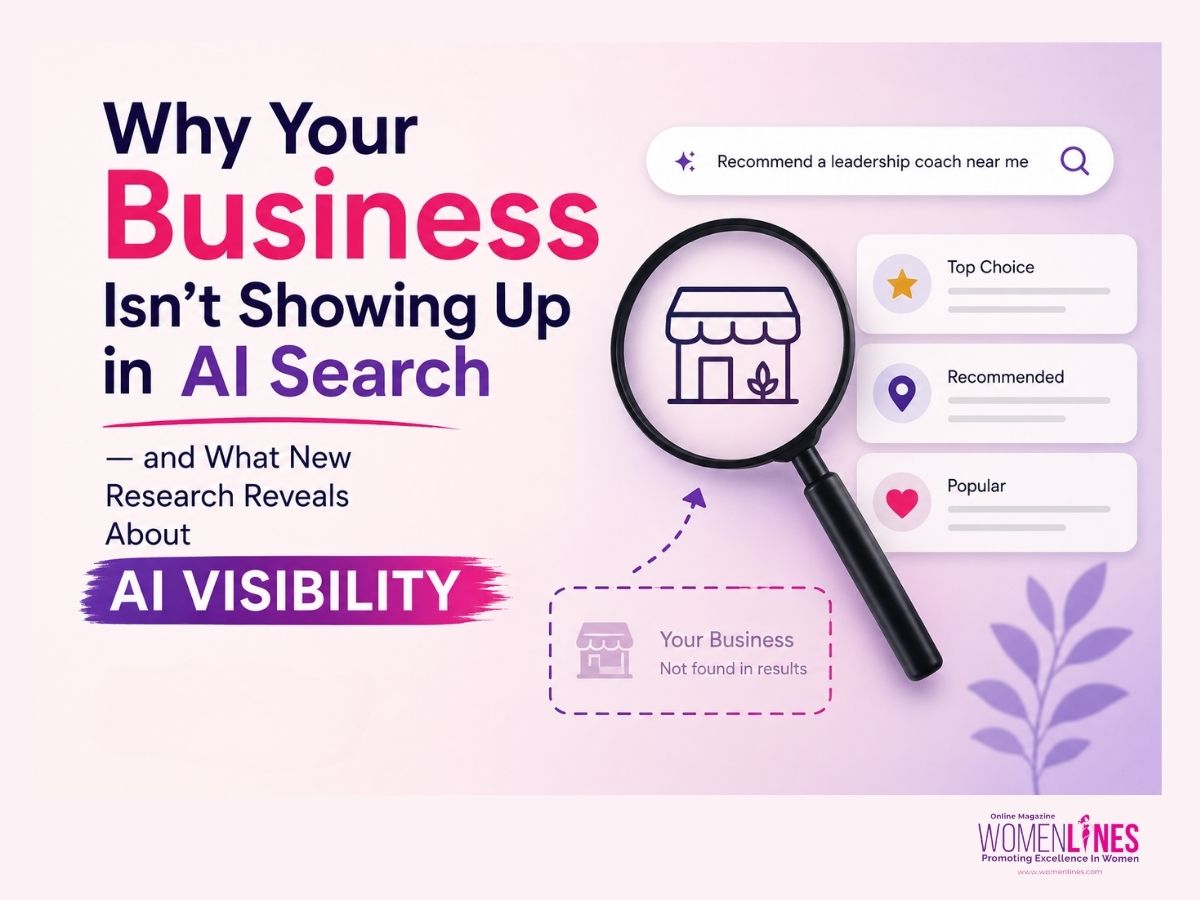
There is a new question I think every business owner should try to understand about AI search.
Open ChatGPT, Gemini or another AI assistant and ask a question that one of your potential customers might genuinely ask.
“Where can I order a good birthday cake near me?”
“Can you recommend a leadership coach in Singapore?”
“What are some good skincare brands for women over 40?”
Then see which businesses appear.
And, perhaps more importantly, see which ones don’t.
A business can have loyal customers, good reviews and years of experience and still be missing from an AI-generated recommendation.
I have been following this shift closely because we spend so much time talking about how businesses can become more visible online. And a study published in August 2026 caught my attention.
The numbers were quite surprising.
Researchers looked at 4,776 businesses. Most were invisible to AI.
Instead of selecting a handful of popular businesses, researchers behind a new study created what they describe as a complete market census.
They mapped 4,776 operating cafés, restaurants and bars in Canggu and Ubud, Bali, and then looked at what happened when four major AI systems — ChatGPT, Claude, Gemini and Perplexity — were asked for recommendations.
The researchers used 96 persona-based queries over seven days, collecting 2,208 responses.
What did they find?
85.6% of the businesses were never recommended by any of the four AI systems.
Not once.
What surprised me even more was what happened to businesses that already had a reasonable amount of customer feedback.
Among venues with 50 or more customer ratings, 72.6% were still never recommended.
You can read the full methodology and findings in the original August 2026 research paper, Invisible to the Machine: Auditing AI Restaurant, Café, and Bar Recommendation Against a Complete Market Census.
That made me wonder:
What was different about the businesses AI did recommend?
Having great ratings wasn’t the whole story
This is where the study becomes particularly useful.
The researchers found that entering the AI recommendation set was associated with factors such as having an official website, having more customer reviews, publishing price information online and receiving mentions elsewhere on the web.
And there was another interesting finding.
A business’s star rating wasn’t a strong predictor of whether it was recommended at all.
Ratings became more relevant after a venue had already made it into the recommendation set — they helped predict which venues were ranked first.
For a more accessible breakdown of the findings, PPC Land analysed what the study found across the 4,776 audited venues.
That distinction matters.
We often assume:
“My customers love me. I have excellent reviews. Surely AI will know I’m good.”
Apparently, it isn’t quite that simple.
My takeaway from the research is this:
Being good at what you do and being clearly documented online are two different things.
The second increasingly deserves our attention.
There is an important caveat here. This was an observational study of hospitality businesses in two locations in Bali. It doesn’t prove that having a website, publishing prices or getting mentioned elsewhere causes ChatGPT or another AI system to recommend a business.
And we shouldn’t assume that exactly the same percentages would apply to a consultant in Singapore, a fashion business in India or a technology company in the US.
But the pattern is certainly worth watching.
Perhaps we need to think about being “understood”, not just being ranked
For years, small-business marketing has revolved around Google.
What keywords are we ranking for?
Are we on page one?
How much traffic are we getting?
Those questions still matter.
But AI adds another question:
Is there enough clear information online for an AI system to understand what my business actually does?
Think about a woman running a home bakery.
Her customers may know that she makes beautiful eggless birthday cakes. They may know she specialises in customised designs and delivers within certain parts of Singapore.
But is that information clearly available online?
Or does her website simply say:
“Beautiful cakes made with love.”
A human who already knows the business might understand that.
But an AI system trying to answer:
“Where can I order a customised eggless birthday cake in Singapore?”
needs much more specific information to potentially identify that business as relevant.
That is why I have started thinking about this as an AI Documentation Advantage.
Not a trick for manipulating AI.
Simply making sure your business is properly represented online.
Then something interesting happened with Reddit
Another development in August reinforced something I think businesses should keep in mind.
For some time, marketers have been paying close attention to Reddit because discussions there frequently surface in search and AI-generated answers.
But third-party monitoring company Promptwatch reported a sharp change in Reddit citations appearing in ChatGPT Search.
According to data reported by Search Engine Land, Reddit accounted for an average 3.83% of citations between July 18 and August 7.
A decline began around August 8, and between August 14 and 17, Reddit’s share reportedly averaged only 0.52% — an 86.4% decline from the earlier period.
You can see the figures and methodology discussed in Search Engine Land’s report on the Promptwatch findings. Forbes also reported on the sharp change in Reddit citations.
That’s a huge movement.
But this is where we have to be careful with the headline.
These figures came from third-party monitoring, not OpenAI, and Promptwatch described its findings as provisional. The company couldn’t establish exactly what caused the change and acknowledged that measurement or data-collection issues could potentially have influenced the size of the reported decline.
So I would not interpret this as “ChatGPT no longer uses Reddit.”
For me, the more useful lesson is much simpler:
Don’t build your entire visibility strategy on one platform.
We learned this with Facebook.
We learned it with Instagram.
We learned it through countless Google algorithm updates.
And we’re likely to learn it again with AI.
Platforms change. Algorithms change. The sources AI systems use can change too.
Your digital reputation therefore needs to exist in more than one place.
Big retailers aren’t waiting to see what happens
This isn’t something only SEO specialists are discussing.
Some of the world’s largest retailers are already paying attention.
Reuters reported in August that companies including Walmart, Ulta Beauty and Wayfair are adapting their websites and digital strategies as consumers increasingly use AI tools for shopping and product discovery.
Adobe Analytics estimates cited by Reuters projected around $8 billion in AI-referred retail sales this year.
Another number caught my attention.
Ulta Beauty told Reuters that visitors arriving through AI platforms were converting at approximately twice the rate of visitors arriving through traditional search and social channels.
That’s one company’s experience, so I wouldn’t generalise that conversion rate to every business.
But it certainly explains why retailers are interested.
You can read the original Reuters report on how retailers are adapting to AI-powered shopping traffic.
And what they’re changing is fascinating.
This isn’t simply about putting more keywords onto product pages.
Businesses are beginning to think about the questions people actually ask AI.
There is a big difference between:
Traditional search: “Best organic skincare Singapore”
and:
Conversational AI search: “What’s a good skincare brand in Singapore for a woman over 40 with dry, sensitive skin?”
The second question tells us far more about the customer.
So perhaps our websites need to do the same.
Instead of simply asking:
“Which keyword should I put on this page?”
we should also ask:
“What questions would my ideal customer ask before choosing a business like mine — and have I actually answered them?”
The AI Documentation Advantage
Putting all of this research together has changed the way I think about online visibility.
I would describe the opportunity like this:
Your website ? Clear information about what you do ? Services, specialties and prices where appropriate ? Genuine customer reviews ? Credible mentions on other websites ? Consistent information about your business online ? Useful content answering real customer questions
To be clear, research has not proven that completing this checklist will make ChatGPT recommend your business.
AI recommendation systems are complex, different platforms work differently, and their systems continue to change.
But several of these signals — including having an own website, review volume, price information and third-party web mentions — were associated with recommendation visibility in the Bali study.
The broader principle makes sense:
Give the web a clearer picture of your business.
What can a small business owner actually do?
This is the part I like most, because you don’t necessarily need a large marketing team.
Start by searching for your own business and looking at what exists online.
Then ask yourself:
-
Does my website clearly explain what I do and who I help?
-
Are my main services and specialties actually written down?
-
Is important information such as location, service area or pricing available where appropriate?
-
Do I have genuine customer reviews?
-
Is information about my business consistent across my website and important listings?
-
Are credible third-party websites talking about my business?
-
Does my content answer the specific questions customers regularly ask me?
There is no guarantee that doing these things will suddenly put your company into every AI answer.
But even beyond AI, this is good digital housekeeping.
It makes your business easier for customers, search engines and potentially AI systems to understand.
The question I think business owners should start asking
For twenty years, we have asked:
“How do I rank on Google?”
We shouldn’t stop asking that.
But now I’d add another question:
“Is there enough trustworthy information about my business online for AI to understand who I am, what I do and when I might be relevant?”
I think that question will become increasingly important.
Especially for small and women-led businesses that may be doing excellent work without having a huge digital footprint.
You don’t have to become famous online.
You don’t have to be everywhere.
But you do need to make it easier for the digital world to understand what makes your business worth discovering.
And that is something we can start working on today.
Sources & Further Reading
The main research behind this article is Invisible to the Machine: Auditing AI Restaurant, Café, and Bar Recommendation Against a Complete Market Census. For a simpler analysis, see PPC Land’s breakdown of the 4,776-venue study.
For the Reddit citation data, see Search Engine Land’s report and Forbes’ additional coverage. For the retail findings, see Reuters’ original reporting on AI shopping traffic.
Charu Mehrotra
Founder Womenlines
This article reflects my personal interpretation and simplification of publicly available data from HubSpot’s 2026 State of Marketing Report. I am not affiliated with or endorsed by HubSpot, and Womenlines is not responsible for any decisions made based on this content — please consult the original report for verified, complete data before making business decisions
Also read: Schema Markup: What I Learned This Week About AI Discoverability
Follow Womenlines on Social Media