I didn’t set out to write about AI or SEO search this week. I was doing something pretty ordinary, checking how a few brands I follow were showing up when people searched for them, when something stopped me. Their rankings looked completely fine. The pages sat right where they should on Google. But when I asked the same questions inside Google’s newer AI search feature instead of the regular search box, some of those same brands simply weren’t there. Not lower down the page. Not on page two. Just absent, like they didn’t exist at all.
That sent me looking for an explanation, and what I found changed how I think about this whole field. Recent usability research suggests that many users frequently accept the first recommendation surfaced by AI search experiences without extensive comparison.”. They don’t compare five options the way they used to. They don’t scroll down to double-check. They take what the AI says, or the business simply never enters the conversation at all.
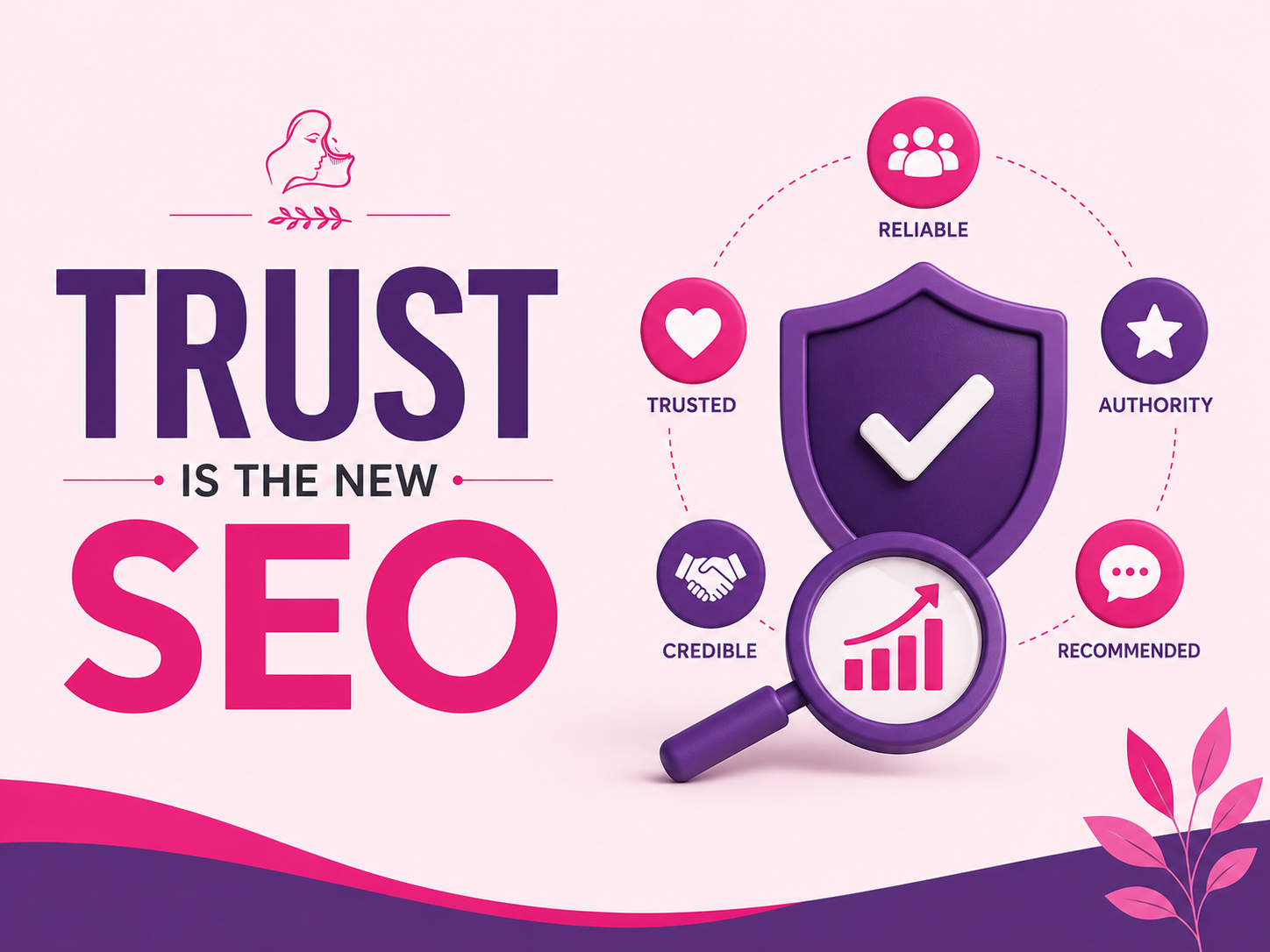
That’s not a ranking problem. It’s a trust problem. And once I noticed it, I couldn’t stop seeing it everywhere I looked this week. So here’s the thesis I kept arriving at as I worked through this issue: trust is the new SEO. For twenty years, getting found online meant optimizing for an algorithm that ranked pages. Now it means earning the kind of credibility that makes an AI confident enough to say your name out loud, and makes a person actually believe it once it does. I went hunting for proof of that shift wherever I could this week, and I found more of it than I expected. Here’s everything I found, explained the way I’d explain it to a friend, fact-checked against the original sources, with every link at the bottom so you can go check my work yourself.
What sent me down this path: Google quietly started grading who it trusts
I started by asking a simple question: why were brands that used to rank perfectly well suddenly missing from AI answers? To figure that out, I looked at what Google has actually changed lately — and found something worth knowing.
Google quietly rolled out two new features. The first is a “Highly Cited” badge — basically a stamp Google puts on articles that other publishers keep referencing a lot. The second is called “Preferred Sources” — it lets regular users pick which websites they personally trust, almost like a favorites list. And here’s the key part: those personal picks now show up directly inside Google’s AI answers.
The numbers back up how much this matters. People are about twice as likely to click a link if it’s from a source they’ve marked as trusted. And already, over 345,000 different websites have been hand-picked by users this way.
While I was looking into this, I confirmed something else too: Google’s AI search tool has now crossed 1 billion users a month, and people are typing in questions that are roughly three times longer than before — less like a quick keyword, more like a full sentence you’d say out loud to a person.
Put those two things together, and it clicks: Google isn’t just quietly ranking websites behind the scenes anymore. It’s openly labeling who it trusts, right out in the open, for everyone to see. Which means being “technically correct” — the right keywords, the right backlinks — isn’t enough anymore. If people don’t trust you yet, and the algorithm doesn’t either, none of that technical stuff matters.
Then I wanted to know what AI actually rewards, so I looked at what gets cited
My next question was simple: if trust matters this much, what does AI actually pull from when deciding who to mention? Recent studies suggest that comparison, ‘Best Of,’ and list-style content appears frequently among pages cited by AI systems.. But the detail that mattered more to me than the format: the sites that won this game weren’t random blogs. They were brands, news outlets, and review sites that already had real credibility built up elsewhere on the internet.
So writing a well-organized comparison article helps, I’ll grant that much. But it only works as a trust shortcut if the rest of your presence already backs it up. The format is just the wrapper. Trust is what’s actually inside it.
A few more things I found along the way
More than two-thirds of Google searches now end without anyone clicking a single link, according to SparkToro’s data, up from under half a decade ago. People are getting their answer right on the search page and moving on, something I’d noticed in my own search habits before I ever saw the data confirming it.
An Ahrefs analysis of 75,000 brands found that simply being talked about by name online, even without a link back to your site, now correlates more strongly with showing up in AI answers than traditional backlinks do, the thing SEO has obsessed over for twenty years.
And maybe the number that stuck with me most: Relatively few marketers report being able to demonstrate measurable business results from AI visibility initiatives.. Everyone’s trying to build trust with AI. Almost nobody can prove it’s working.
So I went looking for who actually knows what they’re talking about
Once I’d gathered all of this, I had one more question: who out there is actually telling people what to do about it, instead of just describing the problem? I spent a good chunk of this week tracking that down, and a few names are worth knowing. I’m naming them here so you can go read the originals yourself.
I found Kevin Indig first, a growth advisor who writes a widely-read industry newsletter called the Growth Memo. He made a point this week that most brands get wrong: AI tools don’t lean on the same websites for every question. For each topic, they tend to trust a small, specific group of writers and experts, and that group changes by industry. His framing, in three words: “depth beats spread.” If you want to actually use this, ask an AI tool a few real questions a customer would ask about your industry, write down which experts or writers it keeps mentioning, and find a genuine way to get featured alongside those same names instead of only publishing more content on your own site. (Search Engine Land, June 17, 2026)
A research firm called Citation Labs pointed out something pretty simple but easy to miss: most businesses write content for the person searching. But in a lot of purchases — especially for businesses selling to other businesses — the person searching isn’t the person who actually decides.
There’s usually someone else sitting quietly behind the scenes who has to approve it. The finance person who questions the cost. The manager who has to sign off. The skeptical partner who says “are you sure about this?” before the credit card comes out.
Citation Labs calls that person “the seat that can say no.” And almost nobody writes for them.
Think about it like this: you can write the most convincing pitch in the world for the person Googling “best accounting software.” But if their boss is the one who actually has to approve buying it, and your content never once addresses that person’s worry — about cost, risk, switching hassle, whatever it is — you’ve convinced the wrong person and lost the sale anyway.
What to actually do about it
It’s simple in practice:
- Think about who really has the power to say “no” to buying what you sell — even if they’re never the one typing the search.
- Figure out their one biggest objection or worry.
- Write something — a page, a post, an FAQ — that speaks directly to that worry, in plain language.
You’re not writing for whoever searches. You’re writing for whoever has to be convinced before the purchase actually happens.
Nick LeRoy made a blunter point that stuck with me: ignoring AI Overviews and AI Mode doesn’t preserve the old status quo, it just hands your spot to a competitor who didn’t ignore it. “If your content disappears from those experiences, someone else will take its place,” he wrote. So pick your single most important “choose us” page and check honestly whether it shows up when you ask an AI tool the question a real customer would actually ask. (Search Engine Land, June 18, 2026)
And finally, I came across Brendon Kraham, Google’s VP of Search and Commerce, who published fresh guidance for marketing leaders that’s worth repeating plainly: getting found in AI search isn’t some brand-new discipline you need to master from scratch, it’s mostly the same fundamentals, clear writing, real expertise, genuinely useful content. He also said outside tools that claim to score your AI visibility “have no access to our internal metrics.” The takeaway: treat any third-party AI visibility score as a rough estimate, not gospel, and spend your time making your content genuinely better instead of chasing a number. (Think with Google, June 2026)
What I’m actually going to do with this, and what I’d suggest you do too
I’ll keep this short, because a list of forty things to do is a list nobody actually does, myself included.
If AI helped write something you’re putting out, say so somewhere. Disclosure is becoming a trust signal, not just a courtesy.
Pick one or two of your best existing blog posts or guides and turn them into a simple “Top 5” or comparison-style article, but only after you’ve made sure the credibility behind it is real.
Make a quick list of anywhere your brand got mentioned recently, in the news, on a podcast, in an online discussion, anywhere, because that kind of mention is outweighing old-school backlinks these days.
Traditional SEO still matters. Trust is becoming an increasingly important layer on top of SEO.
Everything I read to put this issue together
- Fractl & Search Engine Land, “AI search adoption rises as consumer trust declines”, Search Engine Land, June 2026
- Google, “New ways to find your favorite sources and original content in AI Search”, Google Blog
- Search Engine Land, “Google AI Overviews & AI Mode gain preferred sources, plus new perspectives carousel and highly cited labels”, May 2026
- Google, “Google Search’s I/O 2026 updates: AI agents and more”, Google Blog
- Growth Memo (Kevin Indig) & Citation Labs, “How consumers navigate high-stakes purchases in AI Mode”, April 2026
- Kevin Indig, “Topics matter for third-party authority signals”, Search Engine Land, June 17, 2026
- Search Engine Journal, “Google cautions against markdown versions of websites for AI SEO”, June 2026
- Citation Labs, “How to win the gatekeeper’s ‘Yes’ with stakeholder co-citation gap analysis”, Search Engine Land, June 22, 2026
- Nick LeRoy, Search Engine Land, June 18, 2026 (via Search Engine Land’s latest posts index)
- Search Engine Journal, “Google says SEO tools lack access to its internal metrics”, June 2026
- Markana Media, “LinkedIn Algorithm Update June 2026: B2B Reach”, June 2026
- LinkedIn Engineering Blog, “Engineering the next generation of LinkedIn’s Feed”, March 2026
- Digital Applied, “AI search trust decline 2026: Fractl study and AEO strategy” (cites Ahrefs’ 75,000-brand analysis and Fractl’s GEO measurement data)
- Ignite Visibility, “Digital Marketing Industry News” (cites SparkToro’s zero-click search data)
That’s Issue #8. Hit reply and tell me which story actually made you stop and think this week. That’s usually what shapes the next one.
Disclaimer: Information, statistics, rankings, and company data shared in Digital Authority Essentials are sourced from publicly available information believed to be accurate at the time of publication. Womenlines and the author assume no liability for errors, omissions, or subsequent changes. All trademarks, company names, and brand references belong to their respective owners.
Author
Charu Mehrotra
Founder Womenlines.com
Follow Womenlines on Social Media