The most influential women business leaders, especially in today’s climate, tend to focus on building and running multiple companies rather than just one. The world we live in today is built up of international corporate conglomerates that use M&A to dominate industries; in these companies, executives need to set out and oversee different strategies across different brands and steer diverse operations into the path of long term growth. So overall, life at the top of these parent companies is much more complicated. But this sort of leadership shows us all that a strong enough vision can result in success across an entire corporate portfolio.
In this article, I want to shine the spotlight on the women who have worked their way up into these positions of immense power and influence, leading parent companies that steer multiple ships at a time.
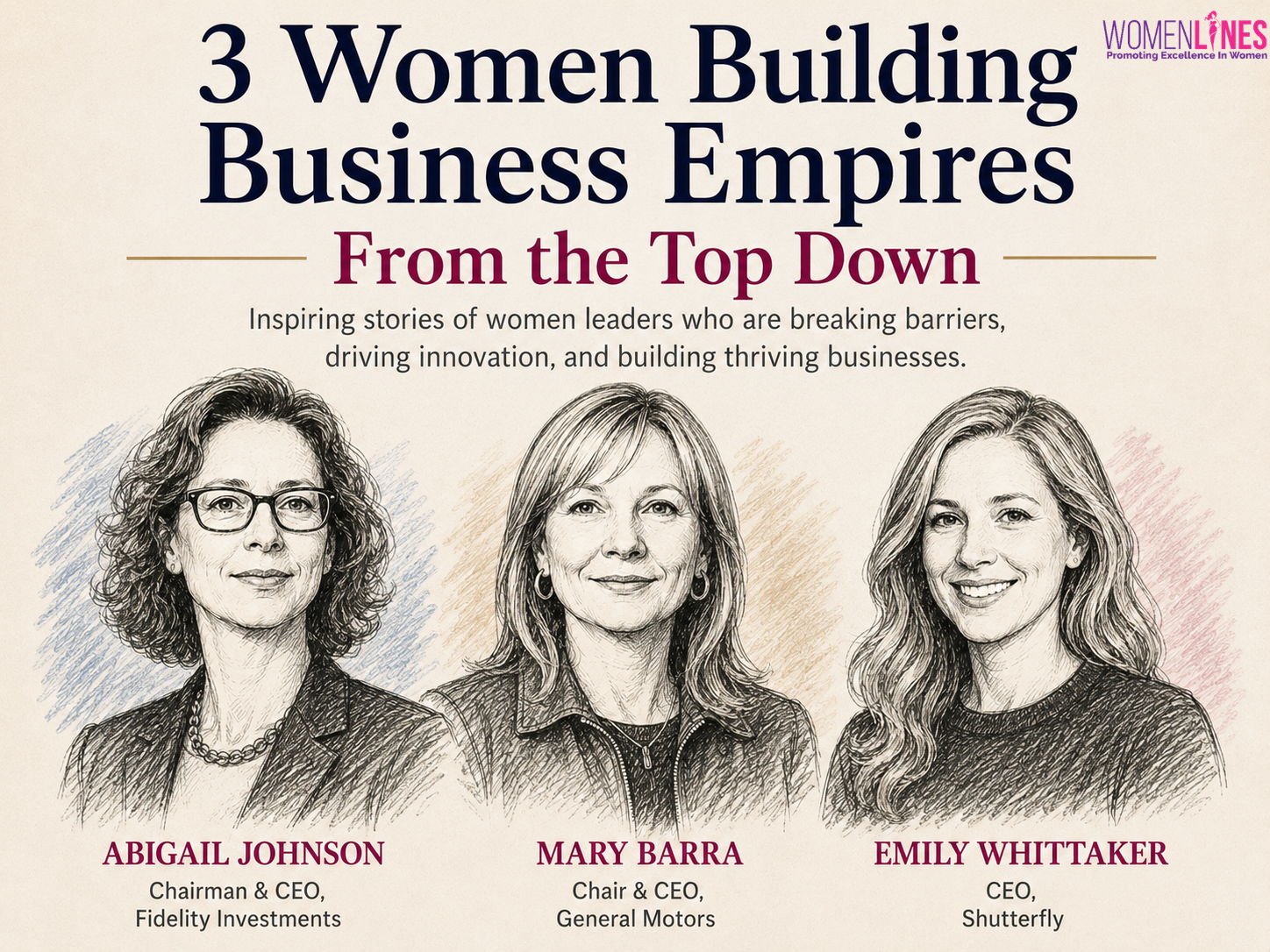
Emily Whittaker and the Shutterfly Family of Brands
Shutterfly might not yet be a household name in most countries, but under Emily Whittaker’s leadership, they are nonetheless cultivating an environment in which companies are experiencing consistent growth. What’s more, these companies all share the same specific niche of offering personalised products and services, but in different ways to different buyers; overall, they are able to serve everyday consumers and organisations via different channels and specialisms.
As CEO, Whittaker oversees the leadership of numerous brands, including Shutterfly, Snapfish, Lifetouch, and Spoonflower. These businesses offer personalised photo products, like photo books, professional photography services, and custom textile designs, as part of a larger, diversified (yet consistent) company that is able to reach a wider audience.
As we’ll see throughout this article, knowing exactly when to prioritise the unique identities of smaller businesses against the broader, larger goals of the parent company is a heck of a balancing act, and Whittaker’s story has been one of setting those priorities strategically in a way that strengthens the portfolio as a whole. Since she stepped into the position, Whittaker has been coordinating investments and operational resources, while looking at the best ways to innovate with new technologies that can satisfy her buyers.
Mary Barra and General Motors’ Expanding Portfolio
Mary Barra might well be one of the most well-known figures in business. The Chair and CEO of General Motors, one of the automotive industry’s biggest corporations, sees her responsible for not only car manufacturers, but also a broad collection of vehicle brands that operate in a wide variety of different sectors.
If we’re purely talking cars and just cars, then GM’s portfolio includes the likes of Chevrolet, Cadillac, GMC and Buick. All of these brands are well-established in the North American auto industry and have built up their own reputations and loyal customer bases over the course of over 50 years.
But Barra is coordinating strategies that don’t just look at the past; she wants to be in pole position to take on the future of motoring. That’s why GM have been committed to strategies that invest heavily in electric vehicles and autonomous driving tech, which – when executed across multiple brands – takes a unified vision and approach.
Barra’s tenure as Chair and CEO of one of the US’s most famous companies shows us how one woman can dominate a so-called ‘male-dominated’ field. She got to work, emphasising innovation and technology to develop the best cars, while still remaining adaptable to the marketplace when necessary.
Unlike Emily Whittaker and Shutterfly, Mary Barra needs to oversee multiple brands who are all in competition with one another in the same industry. This creates its own challenges, as there is an even greater need to differentiate each brand to be uniquely its own, rather than them all homogenising beneath the same banner. But the results are there. Barra has worked her way up at GM since she was an 18-year-old student, and now, she’s led them to bounce back after the 2008 financial crisis and through a pandemic – generating circa $185 billion annually.
Abigail Johnson and Fidelity Investments
Abigail Johnson is the Chair and CEO of Fidelity Investments, which, in case you didn’t know, is one of the world’s biggest financial services engines. In this company, you’ll find layer upon layer of subsidiary after subsidiary, not to mention affiliated businesses. Fidelity is a complicated financial enterprise that provides investment management, pension pots, and brokerage services, as well as broader wealth management services for millions of people all over the world.
So leading this complex machine isn’t easy. Johnson is the captain of a ship that itself is made up of smaller ships – and they all do something slightly different. These specialised business units aim to serve different customer needs, while still operating under the same strategic framework of the parent company – this balances out the wide variety of services on offer with a focused expertise at executive level.
Furthermore, it’s worth pointing out that the world of finance has changed immeasurably in the past 20 years. Technological advancements and shifting customer expectations have moved the industry forwards at an extraordinary pace – and it’s often easier for newer, smaller businesses, like Revolut, to keep up, while behemoths like Fidelity end up left in the dust. But that isn’t what happened.Fidelity evolved with the times due to Johnson’s clear vision and finger on the pulse of a transforming industry.
Closing Thoughts
Overall, these three women each demonstrate success in different models at different scales, within parent companies that are home to diverse business portfolios. It’s all a great balancing act: the individual businesses vs the wider corporation, the long-term plan vs adapting to shifts in the market. No business is the same, yet all have a path to success under the right leadership.
Author
Darcy Fowler
Also Read: The First Five Tools a Solo Founder Should Automate Before Hiring Anyone
Follow Womenlines on Social Media