In the AI economy, every founder has heard the same question so many times this year: will AI replace my business?
It’s the wrong question.
Speaking at HORIZON 2026, a global forum on inclusive trade, frontier finance, and technology-driven transformation, hosted by the Global Council for the Promotion of International Trade, Womenlines founder Charu Mehrotra offered a sharper one: what makes me irreplaceably human?
That single reframe is the foundation of what she calls human-centered entrepreneurship — and it may be the most useful lens any founder can apply to the AI-driven economy in 2026.
AI Isn’t the Disruptor. Distance Is.
Here’s the mistake almost every founder is making right now: treating artificial intelligence as the disruptor.
It isn’t. What’s actually disrupting businesses is distance — distance from the customer’s real emotional reality, distance from the why behind the what, distance between the founder who started the company to solve a genuine human frustration and the dashboard-reading operator they slowly became.
AI didn’t create that distance. It simply made it visible, and brutally fast for whoever closes it first to exploit.
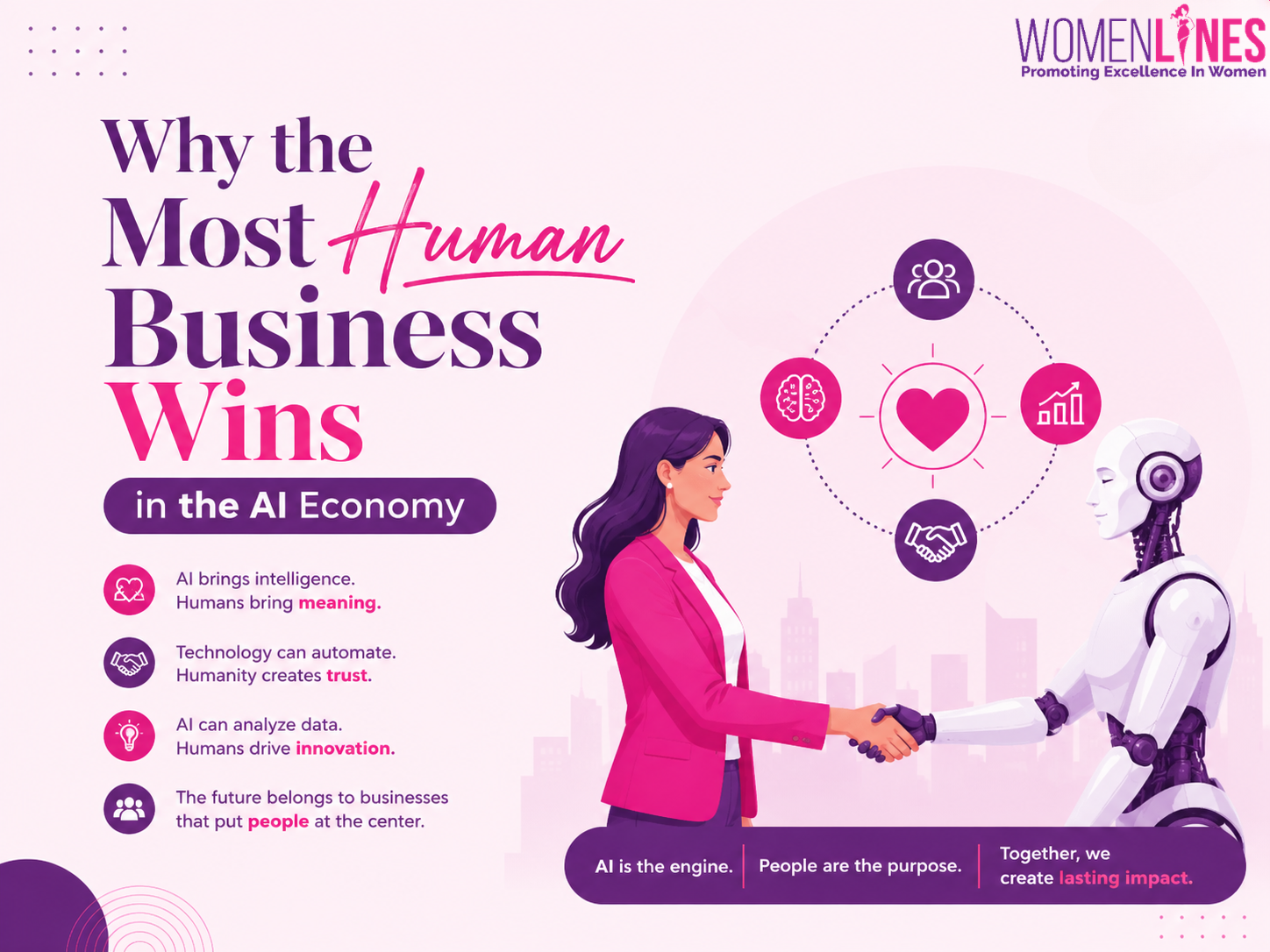
That leads to the one sentence worth carrying out of any conversation about AI strategy: the future doesn’t belong to the most automated business — it belongs to the most human one.
Not “the most human-and-automated.” Not “balanced.” The most human business that also happens to use every automated advantage available to it. Get that order backwards, and you simply build a faster version of a company nobody loved in the first place. Get it right, and AI becomes the most powerful amplifier human-centered businesses have ever had.
We’ve Entered the Age of “Human Premium”
For decades, businesses competed on capital. Then they competed on technology. Today, AI tools are available to almost anyone with an internet connection — technology is being democratized at a pace no previous wave of innovation matched.
And when something becomes abundant, something else becomes scarce.
Call it the Age of Human Premium: in a world where technology is everywhere, humanity becomes the differentiator. Scarcity creates value, and the World Economic Forum has been blunt about where that scarcity now sits — arguing that in an AI economy, being distinctly human is the genuine competitive edge, not simply having the most tools.
The businesses that thrive over the next decade won’t be the ones with the most technology. They’ll be the ones that fuse technology with humanity.
Soft Skills Just Became Hard Currency
For years, communication, creativity, empathy, curiosity, resilience, and leadership were filed away as “soft skills” — nice to have, hard to measure, easy to deprioritize against a sales target.
That framing is now out of date. The World Economic Forum’s Future of Jobs Report 2025 surveyed more than 1,000 employers representing over 14 million workers across 55 economies, and the message is consistent: human capabilities like creative thinking, resilience, leadership and curiosity are climbing the priority list precisely because automation is taking over the tasks that don’t need them.
Technology improves efficiency. Human skills drive innovation, collaboration, trust, and long-term growth. Machines optimize; humans imagine. Machines process information; humans create meaning — and meaning is what moves markets, customers, and investors alike.
The Real Risk Isn’t AI. It’s Intellectual Complacency.
The same WEF report found that employers expect roughly 39% of workers’ core skills — nearly four in ten — to be transformed or rendered obsolete by 2030. At the same time, the global labour market isn’t shrinking: the report projects 170 million new jobs will be created this decade, against 92 million displaced, for a net gain of around 78 million roles worldwide.
So the future of work isn’t disappearing. It’s changing — fast, and unevenly.
That makes one finding from the same research uncomfortable for founders specifically: curiosity and lifelong learning consistently rank among the weakest skills employers report seeing in their workforce, even as those same employers say it’s one of the fastest-rising priorities for the next five years.
That’s the real threat sitting inside most companies right now. Not AI. Intellectual complacency. The moment a founder believes they already know enough, they start becoming irrelevant. Curiosity isn’t a personality trait anymore — it’s a business strategy, and arguably the cheapest form of competitive insurance available to any small or mid-sized enterprise.
Human Skills Are Fragile — and Most Founders Are Letting Them Atrophy
Most of us upgrade our phones every couple of years and our software continuously. Few of us can say the same about our listening, our empathy, our creativity, or our resilience.
That’s not a metaphor — it’s closer to a literal finding from workforce researchers studying skill durability. Human skills behave less like permanent traits and more like muscles: practised intentionally, they grow; left unused, they decline. For founders, that means curiosity, empathy, creativity, adaptability, and communication can’t be left to chance or treated as personality defaults. They have to be cultivated the same way a company cultivates its product roadmap or its sales pipeline — because a business grows at exactly the speed its founder grows.
What AI Still Can’t Do — And Why That’s Your Edge
There’s good news buried in the disruption data. Research into AI-resilient skills consistently points to the same shortlist of capabilities as least susceptible to automation: empathy, leadership, creativity, resilience, curiosity, and teaching or mentoring.
The common thread is that these skills depend on lived experience, relationships, judgment, and context — none of which a model can generate from a training set alone.
AI can analyze data, but it cannot manufacture trust. It can generate content, but it cannot generate conviction. It can predict outcomes with growing accuracy, but it cannot inspire a team through a hard quarter — and leadership, at its core, is an act of inspiration.
Real-World Proof: AI Is Already Scaling Empathy, Not Replacing It
The popular narrative casts AI as empathy’s enemy — the thing that pushed customer service offshore, replaced humans with chatbots, and turned every interaction into a transaction. The data tells a more complicated story. Used well, AI is already closing human gaps at scale, in ways most founders haven’t fully clocked yet.
Customer service. The stakes for getting this wrong are rising fast. TCN’s 2024 U.S. consumer survey found that 63% of Americans now say they’re likely to abandon a brand after a single poor customer service experience — up from 42% just three years earlier, in 2021. Against that backdrop, AI-assisted contact center platforms such as Genesys now surface real-time cues about a caller’s tone and journey stage and suggest phrasing to agents mid-call. The technical pitch is efficiency and staffing flexibility; the deeper value is that it scales emotional intelligence across an entire support team rather than relying on a handful of naturally gifted reps.
Healthcare. This is the example that surprises most people. Physicians at NYU Langone Health are buried under tens of thousands of patient messages a day through electronic health record inboxes. A peer-reviewed study from NYU Grossman School of Medicine, published in JAMA Network Open, had 16 primary care physicians blind-rate hundreds of AI-drafted and human-drafted replies to real patient messages. The AI-generated responses were rated 125% more likely to be considered empathetic and roughly 62% more likely to use positive, affiliative language than the human-written ones — while matching them on accuracy and completeness. The researchers’ own conclusion: thoughtfully deployed AI can lighten clinician workload while reinforcing, not eroding, a culture of compassion.
Organizational knowledge. The larger a company gets, the harder it becomes to keep every department speaking the same language. When engineering can’t articulate the business case and product can’t translate technical constraints, projects stall and revenue walks out the door. AI is starting to function as what some practitioners call a cognitive exoskeleton — pulling context across silos and repackaging it for whoever needs it. Generative AI hubs built to audit planning documents for organizational alignment, and learning platforms that turn static internal files into bite-sized, personalized lessons, are early examples of AI being used to bridge knowledge gaps rather than just cut headcount.
Market reach. For companies expanding into new markets, the barrier is often communication, not infrastructure or cost. Nigeria alone is home to several hundred distinct languages and a large population that doesn’t speak English, the country’s official language; India has well over a thousand documented languages and hundreds of millions of speakers who use neither English nor Hindi as a first language. Serving those populations with traditional, human-staffed channels in every language would be operationally impossible for most businesses. That’s exactly the gap multilingual AI is starting to close: telecom group Orange announced a partnership with Meta and OpenAI to fine-tune AI models on West African languages such as Wolof and Pulaar, with the explicit goal of letting customers — including those who can’t read or type fluently in a national language — interact naturally in their own dialects. Voice systems that read forms aloud and answer in local idioms, escalating to a human only for edge cases, can lower the cost of market entry while actually raising customer intimacy.
The pattern across all four examples is the same: AI doesn’t have to replace the human element of a business. Implemented with intent, it can scale it.
Trust Is the New Currency of the AI Economy
As entrepreneurs, it’s easy to stay focused on products, processes, technology, and scale. Human-centered entrepreneurship asks a different, harder question: whose life genuinely becomes better because my business exists?
Customers don’t only buy products. They buy confidence. They buy relationships, values, and stories — and increasingly, they buy from people and brands they trust. With brand-switching behavior accelerating the way the TCN data above suggests, trust isn’t a soft asset anymore. It’s one of the most economically valuable things a business can build, especially in a market where AI has made it trivially easy for competitors to match your product on price or speed.
A useful way to put it to your team: your story online is your new business card.
Three Mindset Shifts Entrepreneurs Need Right Now
1. Stop asking how to compete with AI. Start asking how to collaborate with it. Many founders still see AI as a threat. It’s more useful to treat it as the most capable business partner most companies have ever had access to — one that can research, draft, analyze, and market faster, freeing up human time for the things that actually require judgment: thinking, building relationships, leading people. The entrepreneurs who win this decade won’t necessarily be the ones using the most AI. They’ll be the ones using it most intentionally.
2. From scale at all costs to meaningful scale. Entrepreneurship has long celebrated growth above almost everything else — more revenue, more customers, more markets. Plenty of founders have since discovered, the hard way, that growth without meaning is a fast track to burnout. The better questions are: how do I grow without losing my values? How do I scale without sacrificing wellbeing? Nobody starts a business purely to generate profit — most founders start a business to create possibility, for themselves, their teams, and the people they serve.
3. In an AI world, personal brand becomes business infrastructure. As AI reshapes how people discover products and services, people increasingly buy from people before they buy from organizations. Your digital presence — your story, your values, your expertise, your reputation — has quietly become a strategic asset rather than an optional extra. In many cases, online credibility now determines whether opportunities come looking for you at all.
Three Commitments to Make This Monday Morning
Not theory. Not philosophy. Practice.
- Before you automate anything, write down — in one sentence — the human reason it existed in the first place. If you can’t write that sentence, you’re not ready to automate that process. You’re just ready to lose it.
- Protect one part of your customer’s journey that stays fully human, no matter how much you scale. Choose it deliberately. That’s where your brand will live or die in a market full of AI-identical competitors.
- Spend the time AI gives back to you on the thing it can’t replace — being in the room with your customer, your team, your own original thinking. Don’t let efficiency quietly steal the hours you got efficient for.
Three Questions Every Entrepreneur Should Take Home
- What uniquely human value do I bring that AI cannot easily replicate?
- How can AI free me up to spend more time on deeply human work?
- Am I building a business that customers simply buy from — or one they genuinely believe in?
AI will write faster than you, price more efficiently than you, and predict more accurately than you. Let it. That was never the real competition. The only competition that’s ever actually mattered — with or without AI — is whether the people you serve feel like a data point, or feel like they matter.
The Bottom Line
The future doesn’t belong to the most automated business. It belongs to the most human one — the one that also happens to use every automated advantage available to it, in that order.
Technology will keep evolving and algorithms will keep improving. Trust, empathy, curiosity, creativity, courage, and purpose remain timeless, and as the World Economic Forum’s research keeps reaffirming, being authentically human is becoming the sharpest competitive edge available in the AI-driven economy. Not simply building smarter businesses — building more human ones.
Frequently Asked Questions
What is human-centered entrepreneurship? Human-centered entrepreneurship is an approach to building and running a business that combines AI and technology with distinctly human strengths — empathy, creativity, trust, curiosity, and ethical leadership — rather than treating automation and humanity as competing priorities.
Can AI really replace empathy in business? Not on its own, but it can scale it. Research on AI-assisted customer service and healthcare communication shows AI tools can help deliver more personalized, emotionally attuned responses at a volume no human team could match alone — when it’s implemented to support people rather than remove them.
What skills matter most for entrepreneurs in the AI economy? According to the World Economic Forum’s Future of Jobs Report 2025, the fastest-rising priorities include analytical and creative thinking, resilience, flexibility, leadership, and curiosity and lifelong learning — skills that are also among the least susceptible to automation.
How can a small business use AI without losing its human touch? Start by identifying the one part of the customer journey you’ll keep fully human no matter how much you scale, automate only the steps whose human purpose you can clearly articulate, and reinvest the time AI saves into direct relationships rather than letting “efficiency” absorb it.
Author
Charu Mehrotra
Founder Womenlines
Also read: How to Build Digital Authority in the Age of AI Search
Follow Womenlines on Social Media