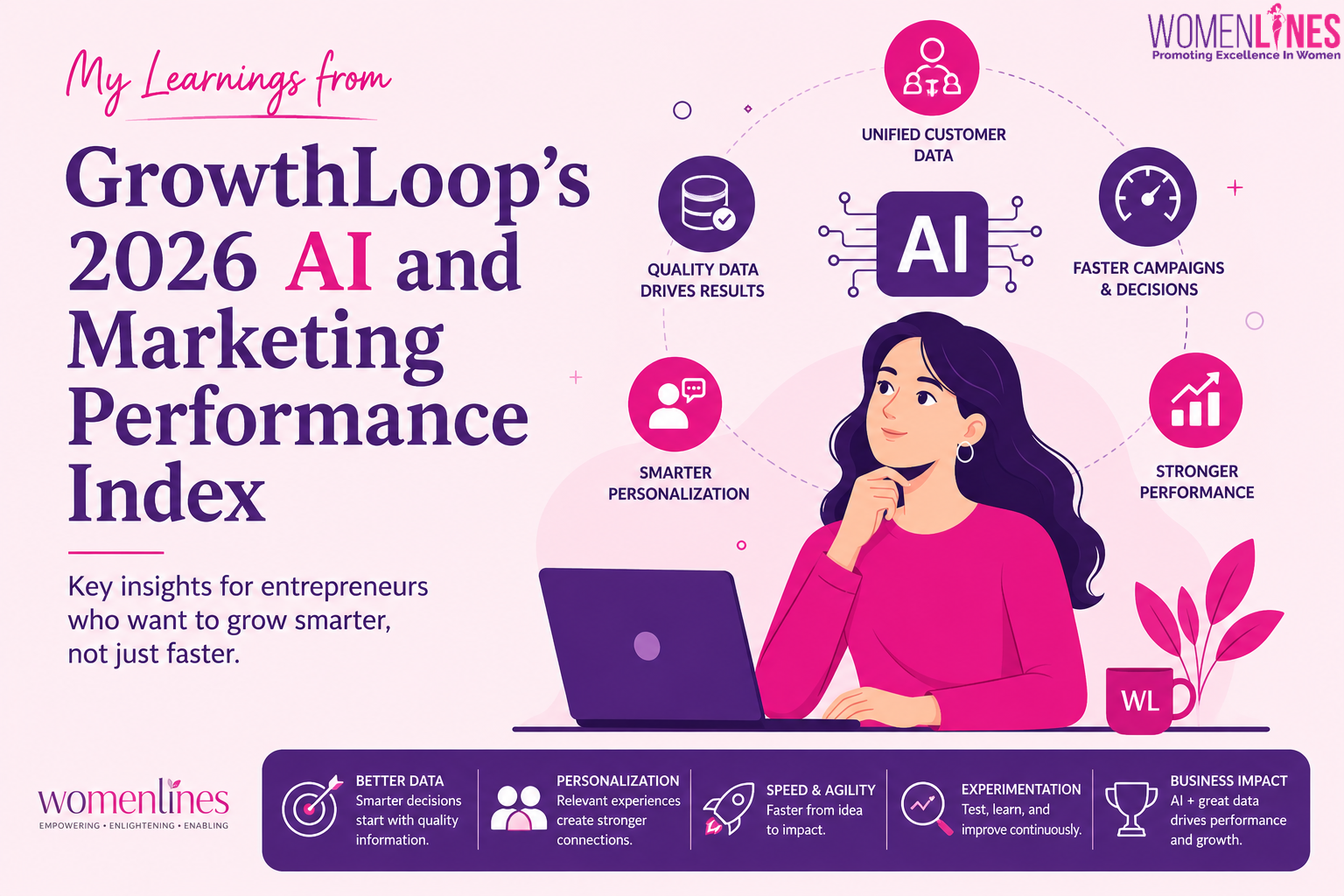
This week’s focus: GrowthLoop’s 2026 AI and Marketing Performance Index
I’ve started a new learning habit.
Every week, I pick one industry report on AI, digital marketing, branding, leadership, or business growth, and spend time actually understanding what it means for entrepreneurs — not just skimming the headline stats.
I’ll be honest: I’ve never been someone who naturally enjoys reading pages full of charts, percentages, and technical graphs. So I now use AI as my learning companion to help me unpack complex reports, understand the bigger picture, and translate the findings into practical lessons. The thinking and conclusions are still my own — AI just helps me simplify the journey.
For this edition, I read The 2026 AI and Marketing Performance Index, published by GrowthLoop in partnership with Ascend2. The research is based on a survey of 318 marketing and data leaders, in managerial roles and above, at large organizations generating $100M or more in annual revenue across the US and Canada. The survey was conducted in February 2026.
You can find the original report here: The 2026 AI and Marketing Performance Index — GrowthLoop
Rather than repeating dozens of statistics, I wanted to answer one simple question: what does this report actually mean for someone running a business?
What the report says
The report in one sentence: Businesses that successfully combine quality customer data with AI are better positioned to deliver faster, more personalized marketing — and stronger business performance overall.
Here are the key lessons, in simple language.
1. AI is no longer an experiment for most marketing teams. Marketing teams are increasingly using AI as part of how they work day to day, not as a side project or a pilot program.
2. Good data matters more than good technology. This is the strongest message in the report: AI is only as useful as the customer data behind it. Poor or disconnected data limits what AI can actually achieve — and the numbers back this up clearly. Companies with a single, centralized source of truth for their customer data reported significant revenue growth 44% of the time, compared to just 8% for companies without one. That’s not a small edge — it’s the difference between AI genuinely working for a business and AI just being an expensive thing people talk about in meetings.
3. A single customer view creates better marketing. Companies that bring customer information together into one trusted, unified source can personalize marketing more effectively and make decisions with far more confidence. Yet the report also shows this is still rare in practice — most teams (58%) are working with a patchwork of historical and real-time data, and only 12% operate primarily off real-time customer context.
4. Personalization is becoming a competitive advantage — but it’s harder than it looks. Businesses that understand their customers well can create relevant, specific experiences instead of sending the same message to everyone. That said, the report found real barriers here too: teams struggle to accurately measure whether personalization is even working, data often arrives too slowly to act on, and tools frequently don’t talk to each other. Data silos between teams actually grew from 21% to 27% year-over-year — meaning this problem is getting worse, not better, despite all the AI investment.
5. Speed matters — and most teams are still slow. The report highlights that organizations want to reduce the time it takes to launch campaigns, test ideas, and respond to customer behavior. But the reality: 54% of teams take 7 to 30 days just to go from idea to campaign launch, and another 41% take even longer than that. AI hasn’t meaningfully closed this gap for most companies, because the bottleneck was never the idea — it’s everything underneath it.
6. Testing leads to better decisions — when it’s trustworthy. High-performing marketing teams continuously experiment and learn from results instead of relying on assumptions. But many “winning” tests don’t survive contact with reality once rolled out company-wide. Companies with unified data are far less likely to run into this problem (8%) compared to those without it (22%) — meaning their results are more repeatable, not just lucky.
7. AI is much bigger than content creation. While many people associate AI mainly with writing, the report shows businesses using it for customer insights, campaign optimization, workflow automation, audience segmentation, and performance measurement. Notably, the report also shows a shift in how marketers see AI’s biggest opportunity — 36% now point to A/B testing and real-time optimization, up from 27% the year before. The conversation is moving from “AI makes things faster” to “AI makes things smarter.”
8. Human expertise remains essential. AI helps marketers work faster, but people still provide the judgment, creativity, strategy, and ethical decision-making that AI can’t replicate on its own.
9. Better marketing starts with better systems, not more tools. Successful organizations aren’t simply buying more AI software. They’re improving the quality of their data, their processes, and how teams collaborate — the unglamorous groundwork that makes AI actually usable.
10. AI is becoming a business capability, not just a marketing tool. The report suggests that organizations treating AI as part of their long-term business strategy are better positioned for future growth than those treating it as a short-term trend to chase.
My reflection
This is where I started thinking beyond the report itself.
Although the research focuses on AI inside marketing teams, it made me reflect on something bigger.
Technology can certainly make businesses faster. But speed alone doesn’t build trust.
As AI becomes part of how people discover information and make decisions, businesses will still need something AI cannot manufacture on its own — credibility.
For me, that’s where digital authority comes in. Digital authority is built when you consistently share knowledge, publish useful insights, contribute original ideas, speak at industry events, participate in meaningful conversations, and become known for solving real problems.
AI can help us create faster. It cannot create genuine experience. It cannot replace years of serving customers. It cannot replace thoughtful leadership. It cannot replace trust.
That’s why I believe founders should keep investing in their personal brand, sharing their expertise publicly, and creating educational content that genuinely helps their audience. The businesses that combine AI efficiency with human expertise will, in my view, have the strongest competitive advantage over the next decade.
My biggest takeaway
Reading this report reminded me that AI should not replace human intelligence. It should amplify it.
The winners won’t necessarily be the businesses using the most AI. They’ll be the businesses using AI to become more relevant, more responsive, and more valuable to the people they serve.
Next edition, I’ll pick up another report and share what I learned from that one. See you then
Disclaimer
This article is an independent summary and personal interpretation of my key learnings from The 2026 AI and Marketing Performance Index, published by GrowthLoop in partnership with Ascend2. It is intended for educational and informational purposes only.
All research findings, data, charts, and intellectual property remain the property of their respective owners. This article does not reproduce the report in full or represent the views of GrowthLoop or Ascend2. Readers are encouraged to refer to the original report for the complete research methodology, findings, and context..
Author-
Charu Mehrotra
Founder Womenlines
Also read:Human-Centered Entrepreneurship: Why the Most Human Business Wins in the AI Economy
Follow Womenlines on Social Media