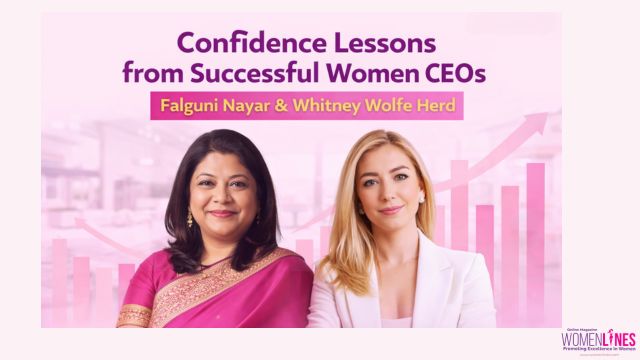
Confidence Lessons from Successful Women CEOs
Let’s start with a number: 50.
She Was 50 yrd old. She Had No Experience of running a startup. She Built a Billion-Dollar Empire Anyway.
That’s how old Falguni Nayar was when she walked away from a glittering investment banking career she was having, looked the world in the eye, and said —I’m just getting started.
That bold move led to the creation of her company Nykaa — today one of India’s leading beauty and lifestyle platforms. started by Falguni Nayar in 2012, Nykaa began as an online marketplace offering authentic beauty and skincare products from global and Indian brands. It quickly grew amazingly into a full-scale beauty ecosystem.
Nykaa doesn’t just sell cosmetics. It also curates skincare, makeup, haircare, wellness, and fashion products, also operates physical retail stores across India, and produces original content — tutorials, expert advice, product education — helping customers make informed choices.
Blending content, commerce, and community, Nykaa transformed how Indian consumers discover and shop for beauty, building trust in an industry once dominated by offline retail only.
No tech background. No startup experience. Just an unshakeable belief that she deserved to be the Nayika — the heroine — of her own story.
Today, Nykaa is a household name across India. And Falguni Nayar is proof that the world’s most dangerous woman isn’t the youngest one in the room. She’s the one who finally stopped waiting for permission.
Now Meet the Woman Who Got Sued, Silenced — and Came Back to Build a Billion-Dollar Company
Let’s start with a number: 25.
What if a young woman in her twenties refused to let a public setback define her future — and instead built one of the world’s most talked-about tech platforms?
That’s the story behind company Bumble.
Founded in 2014 by just 25-year-old Whitney Wolfe Herd, Bumble changed the rules of online dating by giving women the power to make the first move. But the idea was born from resilience only.
Many are not aware that before Bumble, Whitney was a co-founder of Tinder. After leaving the company, she filed a highly publicized lawsuit alleging workplace harassment and discrimination. The case drew massive media attention and was eventually was settled. For many, such an experience could have ended a career and might have led to demotivation
For Whitney, it became fuel instead which helped her to move to enxt level of her life.
Deciding not to step back, she dared to step forward — launching Bumble with a clear mission: create a safer, more respectful digital space where women feel empowered.
Bumble began as a dating app, but soon expanded into:
-
Bumble Date
-
Bumble BFF (friendships)
-
Bumble Bizz (professional networking)
In 2021, Whitney became one of the youngest female CEOs to take a company public in the U.S., proving that setbacks can become powerful foundations for somebody who is just determined to keep moving.
Bumble isn’t just a tech success story — it’s a story of a young founder who turned adversity into innovation and built a global movement around empowerment.
So What Do These Two Women Actually Have in Common?
They didn’t wait to feel ready. They didn’t wait for the right age, the right moment, or the right people to believe in them first.
Here’s what their journeys actually teach us —
1. Confidence is not a feeling. It’s a decision you have to take on your own. Falguni didn’t wake up one morning overflowing with confidence. She made a promise to herself in 2009 — before I turn 50, I will begin. She gave herself a deadline and just made sure she kept it. That’s not confidence. That’s commitment followed by confidence.
2. Your setback also can have a market. Whitney didn’t just healed from her past experience — she productised it instead. The pain of being silenced became a platform that gave millions of women a voice. Ask yourself: what experience have you been through that others are still suffering in silence?
3. The world will always have a reason you shouldn’t do. Too old. Too inexperienced. Too emotional. Too ambitious. Both women heard versions of these objections. Neither made it their headline.
The Real Confidence Lesson Nobody Frames This Way
We talk about confidence like it’s something the lucky ones are born with and they are able to achieve what they want. Like Falguni Nayar walked out of IIM Ahmedabad ready to conquer the world, or Whitney Wolfe Herd never doubted herself for a second.
That’s not their story.
Their story is messier, realer, and far more useful to the rest of us.
Falguni spent years watching others chase their dreams before she chased her own. Whitney spent time in courtrooms before she stood on a trading floor. The confidence didn’t come first. The action did. And confidence came along for the ride.
One Question Before You Keep Scrolling
What are you waiting for?
Genuinely!
Because somewhere between “I’m not ready yet“ and “it’s too late now” — there is a window. It doesn’t have an age limit. It doesn’t require a perfect plan. It just requires you to decide that your story is worth telling, your product is worth building, your voice is worth raising.
Falguni Nayar decided at age 49. Whitney Wolfe Herd decided at age 25.
When will you decide? Act now!
At Womenlines, we don’t just tell women’s stories. We make sure they travel. Because the world gets better when bold women are heard louder.
Explore more at womenlines.com
Frequently Asked Questions (FAQs)
1. What can women learn from Falguni Nayar’s journey?
Falguni Nayar teaches that confidence is not at all age-dependent. Starting Nykaa at 50, she proved that timing is personal and experience can become a competitive advantage in entrepreneurship.
2. How did Whitney Wolfe Herd demonstrate confidence early in her career?
Whitney Wolfe Herd became the youngest female CEO to take a company public at 31. Her journey shows that confidence is built through daring to take bold decisions, even after setbacks.
3. Is confidence something you’re born with or something you build?
Both leaders show that confidence is built through action with consistency, resilience, and clarity of vision — not inherited by birth or instant.
4. Why is conviction important for women entrepreneurs?
Conviction helps women stay committed to their vision despite criticism, doubt, or external pressure. It allows long-term brand building instead of reactive decisions.
5. How can women develop leadership confidence?
Leadership confidence grows through:
-
Consistent decision-making
-
Learning from failure
-
Building expertise
-
Surrounding yourself with the right mentors
6. What role does age play in entrepreneurial success?
Age is not a limitation. The article highlights how both early and later-stage entrepreneurship can lead to massive success when supported by belief and execution.
7. What makes these CEOs different from other business leaders?
Their businesses didn’t just grow financially — they shifted power dynamics in their industries and empowered women through their brand philosophy.
8. How can aspiring women entrepreneurs apply these lessons?
By:
-
Taking action before feeling “ready”
-
Building patiently instead of rushing growth
-
Turning setbacks into strategy
-
Leading with conviction
Author-
Arpita Dongre
Intern Womenlines
Also Read: How Successful Women CEOs Start Their Day: Daily Habits Revealed
Follow Womenlines on Social Media