
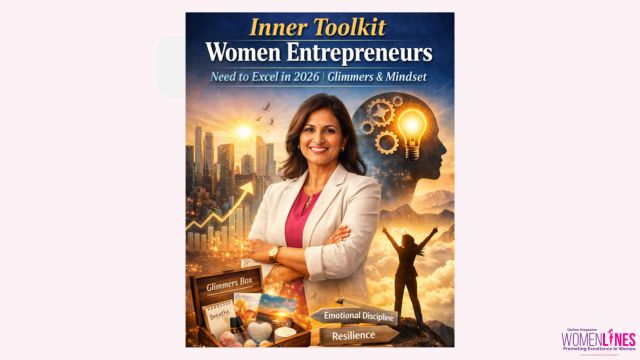
Discover the inner toolkit women entrepreneurs need to excel in 2026—emotional discipline, self-management, glimmers, shifters, and a champion mindset.
Why Women Entrepreneurs Need a Different Kind of Toolkit in 2026?
Because when women learn to manage their inner world, their ventures naturally reflect clarity, confidence, and consistent growth.
In 2026, success will not be defined only by revenue, visibility, or speed of growth. It will be defined by how well women entrepreneurs manage themselves—their energy, emotions, focus, and internal communication.
Skills can be learned. Systems can be built.
But without emotional discipline and intentional self-leadership, even the strongest ideas collapse under pressure.
This article explores the inner toolkit that women entrepreneurs need to excel in the coming years—one built around Triggers, Shifters, and Glimmers.
My entrepreneurial journey did not follow a straight line. After moving to Singapore nearly 17 years ago, I stepped into entrepreneurship without a business degree, without a clear blueprint, and without certainty.
I began with a clothing venture, partnering with a friend to bring hand-embroidered designs from India to Singapore. The product was strong, but the cost of marketing and the challenge of consistent visibility taught me an early lesson—entrepreneurship is as much about endurance as it is about creativity.
This led to the launch of a networking and events company, Udaan in partnership with a dear friend. Three years of building community, learning the market, and showing up consistently were followed by the exit of my partner. At the same time, I was navigating second motherhood journey and personal transitions—an experience many women entrepreneurs will recognize.
A tech startup ‘Earngo’ followed again in partnership with a friend who has business degree and tech background, incubated at SMU. Technology was unfamiliar terrain, yet determination, continuous upskilling, and belief in learning on the go helped us secure SGD 50,000 in government funding. The journey was rewarding, but it was also demanding. When the venture eventually closed, it marked the third time I had started—and ended—a company in Singapore.
What I gained from these experiences was not failure.
I gained self-mastery.
What Entrepreneurship Taught Me About Emotional Discipline
Over time, I realized that the most consistent challenge in entrepreneurship was not strategy or funding—it was how I managed myself during uncertainty.
Every entrepreneur encounters:
- Rejection
- Delays
- Financial pressure
- Role overload
- Self-doubt
For women, these challenges are layered with additional emotional and social responsibilities.
The difference between those who sustain themselves and those who burn out often lies in inner regulation, not external success.
This realization deepened through my work at Womenlines, where I have interviewed 200+ women leaders and entrepreneurs from across the globe. Across industries and cultures, the same pattern emerged: women who thrive long-term have learned how to work with their inner world.
Understanding Triggers: The First Step to Self-Leadership
Triggers are emotional responses that pull us out of clarity. They are not weaknesses—they are signals.
What drains women entrepreneurs is not the trigger itself, but:
- the time spent replaying it
- the self-talk that follows
- the energy lost in reaction
When we learn to identify what triggers us, we regain choice.
Mindset Shifters: From Reaction to Response
Shifters are conscious mental and emotional tools that help us regulate and refocus.
Key Mindset Shifters
- This feeling is information, not instruction.
- Pause before proving, explaining, or defending.
- Ask: What is really being touched here?
- Name the trigger silently—naming reduces its power.
- Replace Why is this happening to me? with What is this teaching me?
- Choose clarity over control.
- Separate intention from impact.
- Delay reaction by 90 seconds to allow the nervous system to settle.
Language Shifters
- “I must respond now” ? “I can respond later”
- “They are against me” ? “This is about them, not me”
- “I’m failing” ? “I’m learning under pressure”
- “This always happens” ? “This is one moment, not my entire story”
These shifts protect mental energy and restore perspective.
Glimmers: Small Anchors That Restore Balance
Glimmers are moments that create a sense of safety and grounding. They regulate the nervous system and help the mind return to clarity.
Examples include:
- A warm cup of tea or coffee
- A familiar song or instrumental music
- Sunlight through a window
- A calming scent
- A deep breath that slows the body
- A kind message or shared laughter
These moments may seem small, but their cumulative effect is powerful.
The Glimmer Box: A Practical Tool for Daily Regulation
I encourage women entrepreneurs to create a Glimmer Box—a physical collection of grounding items such as:
- A photo of loved ones
- Essential oils
- A handwritten affirmation
- A small notebook
- A comforting object
When triggered, opening the box helps shift the body into a regulated state before the mind attempts to solve anything.
Daily Practices That Strengthened My Champion Mindset
I didn’t develop resilience in one defining moment.
It was built quietly—through ordinary days, repeated choices, and small practices I returned to even when motivation was low.
Over time, I realised that mental strength isn’t created during breakthroughs.
It is created in the in-between moments—the days no one applauds.
These are the daily practices that strengthened my champion mindset and helped me stay anchored through uncertainty, reinvention, and growth.
1. Intentional Journaling: Where Clarity Began
Journaling became my safe space long before it became a habit.
On days when everything felt noisy—decisions, expectations, emotions—I turned to the page. Writing helped me slow down enough to hear myself think. It showed me what truly mattered, what was draining me, and what kept triggering the same emotional loops.
Over time, I noticed something powerful:
the more honestly I wrote, the more clearly I led.
Journaling didn’t just help me plan—it helped me understand myself.
2. Movement and Grounding: Returning to My Body
There were phases in my journey when my mind was constantly ahead—planning, worrying, solving. My body, however, was left behind.
Movement brought me back.
Whether it was a walk, yoga, breathwork, bollyaerobics or simply standing barefoot on the ground, these practices became a reset button. They reminded me that calm doesn’t come from thinking harder—it comes from regulating the body first.
When I started grounding regularly, my reactions softened.
My patience grew.
My clarity returned.
3. Nutrition and Energy Awareness: Learning to Respect My Limits
For a long time, I underestimated how deeply food and energy are connected to mindset.
Caffeine spikes, emotional eating, irregular meals—these patterns quietly affected my focus and emotional balance. Once I began paying attention—not with restriction, but with awareness—I felt the shift.
Mindful nutrition taught me a simple truth:
you cannot lead well if you are constantly running on empty.
Energy management became as important as time management.
4. Conscious Networking: Choosing Energy Over Obligation
As entrepreneurs, we often feel pressure to stay connected everywhere. But I learned that not all connections nourish.
Some conversations drained me.
Others expanded me.
I became intentional about who I spent time with, who I listened to, and who I allowed into my inner circle. The right people didn’t just inspire me—they steadied me.
Your network doesn’t just shape your opportunities.
It shapes your mindset.
5. Time and Energy Planning: Simplifying the Noise
There was a time when my to-do lists were endless—and exhausting.
Eventually, I stopped asking, How much can I do today?
And started asking, What truly matters today?
Focusing on outcomes instead of urgency changed everything. Planning with energy in mind—not just deadlines—helped me show up with presence instead of pressure.
Some days, doing less meant leading better.
6. Self-Communication: The Quiet Voice That Changed Everything
Of all the practices, this one transformed me the most.
I became aware of how I spoke to myself—especially on hard days. The inner criticism, the impatience, the unrealistic expectations.
When I softened that voice, something shifted.
I learned that leadership begins internally.
The words we choose with ourselves shape how we respond, decide, and endure.
Compassionate self-communication is not self-indulgence.
It is emotional discipline.
7. The Magic of Pranayama: Learning to Breathe Before I React
I discovered the power of pranayama not during calm phases—but during moments when life felt overwhelming.
There were days when my mind was racing ahead while my body carried the weight of uncertainty. No amount of thinking could settle that restlessness. That’s when I realised something essential: before managing the mind, I had to regulate my breath.
Pranayama taught me to pause without forcing stillness.
A few intentional breaths—slow, deep, and conscious—created space between the trigger and my response. In that space, clarity appeared.
With regular practice, I noticed subtle but profound changes:
-
My reactions softened
-
My focus improved
-
My emotional endurance increased
Breathing became my anchor. Not as a ritual, but as a tool I could return to anytime—before a difficult conversation, after a long day, or during moments of self-doubt.
Pranayama reminded me that calm is not something we wait for.
It is something we generate—one breath at a time.
And in an entrepreneurial journey filled with unpredictability, this practice became one of my most reliable inner supports.
These practices didn’t make my journey easier.
They made me stronger.
They helped me stay present, grounded, and intentional—especially when things didn’t go as planned.
And if there’s one thing I’ve learned, it’s this:
You don’t become a champion by pushing harder.
You become one by learning how to hold yourself—daily.
Final Thought: What 2026 Will Reward
The women entrepreneurs who excel in 2026 will not be those who push the hardest—but those who manage themselves with wisdom, compassion, and intent.
Entrepreneurship is not only about building companies.
It is about building the woman who sustains them.
And that journey begins from within.
Author Note
Charu Mehrotra is the founder of Womenlines, a global media platform spotlighting women leaders, entrepreneurs, and changemakers. Subscribe to www.womenlines.com
for exclusive content on personal transformation in health, leadership, and business skills.
.
Follow Womenlines on Social Media